
America is full of river cities where the proximity to water facilitates a fluid exchange of individuals and economy. But not many have as symbiotic and beneficial a relationship as Cincinnati and Newport, except perhaps Cincinnati and Covington.
Kentucky’s northernmost river city has its own rich waterfront history, and with a number of ongoing development projects coming online it’s time for the city to step into the spotlight. “We’re all incredibly proud of Newport because it has a rich history and great people and we have momentum,” says Newport Mayor Tom Guidugli Jr., a lifelong resident and member of a prominent Newport family.
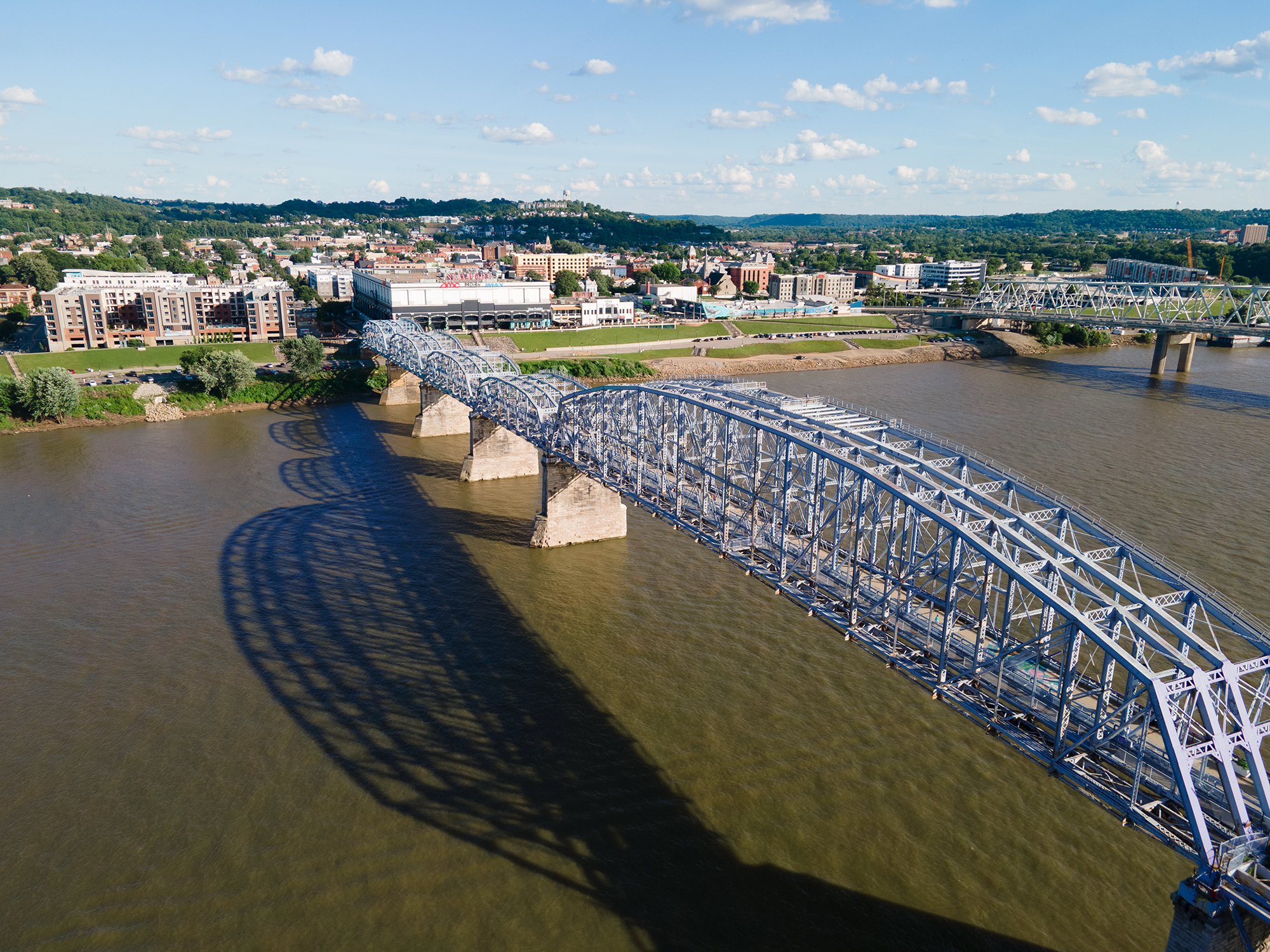
City government is spearheading renovation of the 154-year-old Purple People Bridge and transformation of Festival Park, the asphalt lot below Newport on the Levee that hosts favorite festivals like Italianfest and Goettafest. Ovation, a 25-acre mixed-use development at the western edge of Newport, continues to expand its housing options.
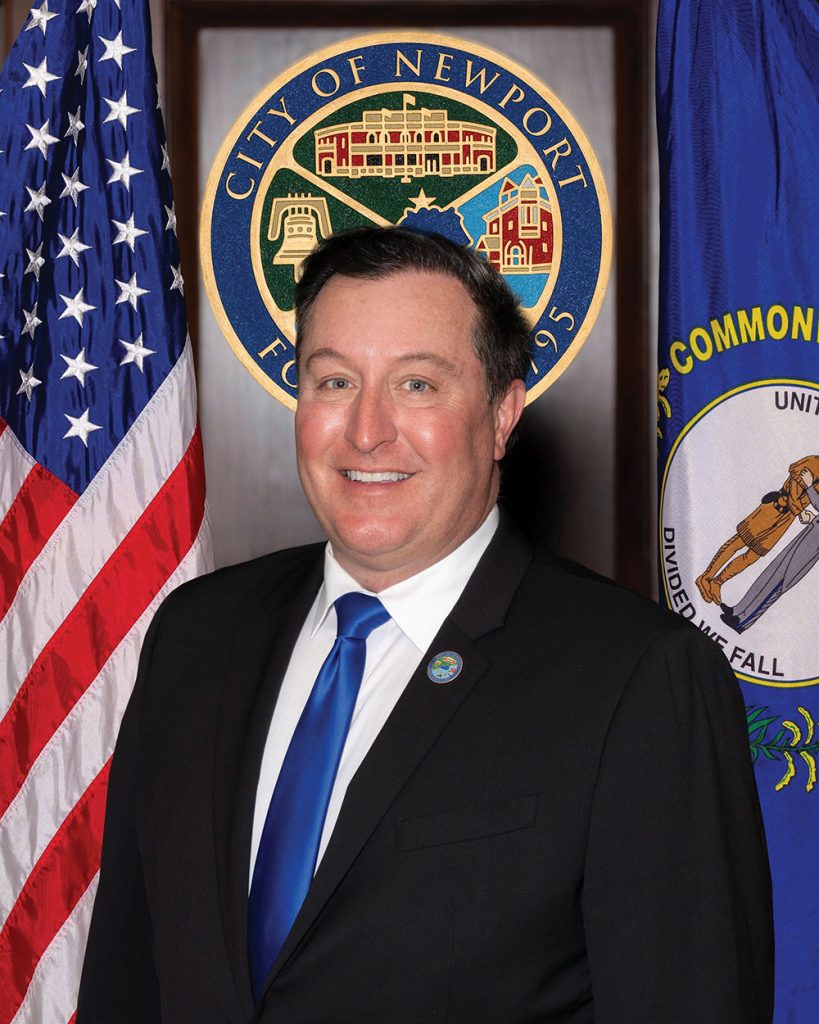
“If you look at the city of Newport and how it was built, it was originally one of the first walking cities built in an era when walking and even cycling was popular,” says Guidugli. “The basin area is very flat and very walkable, which interestingly are attributes that newly-designed communities copy in a modern way.”
Guidugli, elected as mayor in 2020 and serving as vice mayor before that, travels a fair amount for his position, scoping out how other cities in the country have made their specific infrastructure work. Take Carmel, Indiana, for example, one of his most recent stops. The Indianapolis suburb’s emphasis on careful planning that accommodates pedestrian and bike access is something he wants Newport to emulate.
“We can reintegrate some of the things that are making their community successful on our Monmouth Street corridor,” he says. “It’s possible to make Newport more walkable and more connected through bump outs and other opportunities.”
Monmouth Street was originally a two-way street until retail and growth and increased traffic lead to its conversion to a one-way street heading north toward the river, but talk of conversion back to two-way has been floated for several years now. A feasibility study was greenlit in 2025 to explore its potential. “We’re trying to evaluate how that becomes more walkable as a two-way street with the challenges of it also being a state route (Route 27),” says Giudugli.
(Drone photo at top by Justin Schafer)
Designated a historic district 30 years ago in 1996, Monmouth runs through the heart of Newport and connects to Cincinnati via the Taylor Southgate Bridge. Parallel to Monmouth is Saratoga Street, which connects to Ohio via the Purple People Bridge.
The bridge, opened in 1872, was the first railroad bridge on the Ohio River here and a key facilitator in stitching together Cincinnati, Newport, and Covington. It was reconstructed and modernized in 1896 to accommodate heavier and more frequent train trips. Originally called the Newport and Cincinnati Bridge, it’s changed ownership and purpose several times over subsequent years, reconfigured to accommodate streetcar tracks, a pedestrian sidewalk, a carriage road, and eventually automobiles.
By 2001, the bridge had permanently closed to automobile traffic. Known then as the Louisville & Nashville Railroad Bridge, it was owned jointly by the state of Kentucky and CSX Railroad. The state briefly explored demolishing it, which would have cost around $5 million. Instead, the city of Newport and Southbank Partners, a nonprofit economic development group focused on regional interests in Northern Kentucky’s urban core, came together to request ownership and keep the bridge standing.
CSX donated its ownership portion to Southbank Partners, and Kentucky donated its portion to the city. Together, the two new owners formed a nonprofit, the Purple People Bridge Company, to take over maintenance and operations. The Kentucky Legislature agreed to paint and restore the bridge, to the tune of $4 million. For more than two decades, the Purple People Bridge Company operated the bridge as pedestrian-only.
Southbank Partners handled day-to-day maintenance, but closures of the bridge in 2021 and 2024 resulted in a strong community reactions. It became clear that Newport residents loved and utilized the Purple People Bridge on a daily basis. City numbers show that around 700,000 people cross the bridge every year, which works out to roughly 1,800 to 2,000 people per day.
“We knew there needed to be more investment in the bridge, so we put it under a microscope to say, What does it need? How do we get to a point where it’s sustainable and enhanced for us and for the whole region?” says John Willis, Newport’s economic development co-ordinator.
Conversations began in early 2025 between Newport and the Purple People Bridge Company about the bridge’s future. The groups ultimately decided that it would be best to have the city in charge in order to obtain necessary funding, and so Newport took over full ownership of the bridge in September 2025. “It was a big day for us, and we really got to work right away,” says Willis. “Literally that week we knew there were some housekeeping items we could go in and take care of.”
Newport convened a steering committee of regional leaders in both Cincinnati and Newport to usher in the bridge’s next chapter of life. The committee introduced the People’s Bridge Project as a collaborative campaign to “reinvest in infrastructure that connects us,” according to a presentation the group gave to MeetNKY, Northern Kentucky’s tourism bureau, last year.
During the Purple People Bridge Company era, the bridge’s business model entailed hosting various private and public events. Anyone could host an event on the bridge for a fee. The process worked, but Willis says it isn’t practical to use that model at the scale necessary for long-term sustainability and success.
“With the level of infrastructure improvements that we would likely want to do, treating it as an event center is probably not going to get it done,” he says. “So the concept we’ve been rolling with is that it’s a park with a purpose. A park in the sense that you know it’s a community space owned by public entities, but in reality that means it’s owned by every single person who walks on it.”
The Purple People Bridge is the longest pedestrian bridge in the U.S. It currently has an 18-foot-wide multi-use path, a 6-foot-wide walking path, and an additional 17-foot-wide unused space. The committee is reimagining the empty stretch as a flex space suitable for activities and activations.
“The Purple People Bridge has a protected bike path and is one of the most activated corridors in the entire region for walkers and bikers,” says Guidugli. “We’re really excited about reinvigorating our partnership with the city of Cincinnati and all the agencies that are going to be available to support and make this a truly special place.”
That partnership began with much-needed permanent repairs on the Cincinnati side. As a measure of goodwill, according to Guidugli, Newport stepped forward to secure partners and dollars to make that permanent fix. Newport was then able to secure $2 million in funding from Kentucky’s state budget for fiscal year 2027-28, specifically for an LED lighting concept on the bridge. The Cincinnati Regional Chamber is in the early steps of commissioning a lighting study of all Ohio River bridges, and Willis reached out to bring Newport into the conversation. He says a full-scope engineering study of the bridge is also on Newport’s list of priorities.
“We think bridge usership could be one million people a year with more activation around,” says Willis. “People rely on it to get to things over in Cincinnati, like Bengals and Reds games, they’re walking over to festivals in Cincinnati and vice versa, and they’re also walking to work.”
BE NKY Growth Partnership contributes research and analysis to help Newport, Campbell County, and all Northern Kentucky jurisdictions make the case for new investment from prospective businesses. The economic development organization has helped Newport align major projects with broader regional growth goals, including the Purple People Bridge. “When economic development works and works well, it’s a team game,” says BE NKY CEO Lee Crume. “Partners support each other and pick each other up, including working with Newport on the bridge. We have a channel of work we call Data-Informed Community that creates content or research and data.”
During the Purple People Bridge closure in 2024, NKY Port Authority Executive Director Christine Russell came away from a community meeting with real enthusiasm for accelerating the bridge’s reopening. It was just before Riverfest, the start of the Bengals season, and the latest iteration of BLINK. The bridge was vitally important to keep Northern Kentucky in the conversation among the region’s key cultural events.
“She brought some focus and attention to it and got the initial dollars to get it shored up and get it opened,” says Crume. “BE NKY, Greater Cincinnati Foundation, MeetNKY, Procter & Gamble, Western & Southern, Eastern Row Historic Foundation, and RJE Furniture all contributed dollars to get the bridge re-opened. I think that process brought it to the city of Newport’s attention saying, Hey, we need to think of this thing as an amenity in a different way. And credit to Newport for picking up the ball at that point and saying, OK, now we’re going to run with it.”
The Purple People Bridge renovation isn’t the first time Newport has made an effort to redefine itself, of course. To many regional leaders, Newport on the Levee served as the first positive catalyst for change in Northern Kentucky.
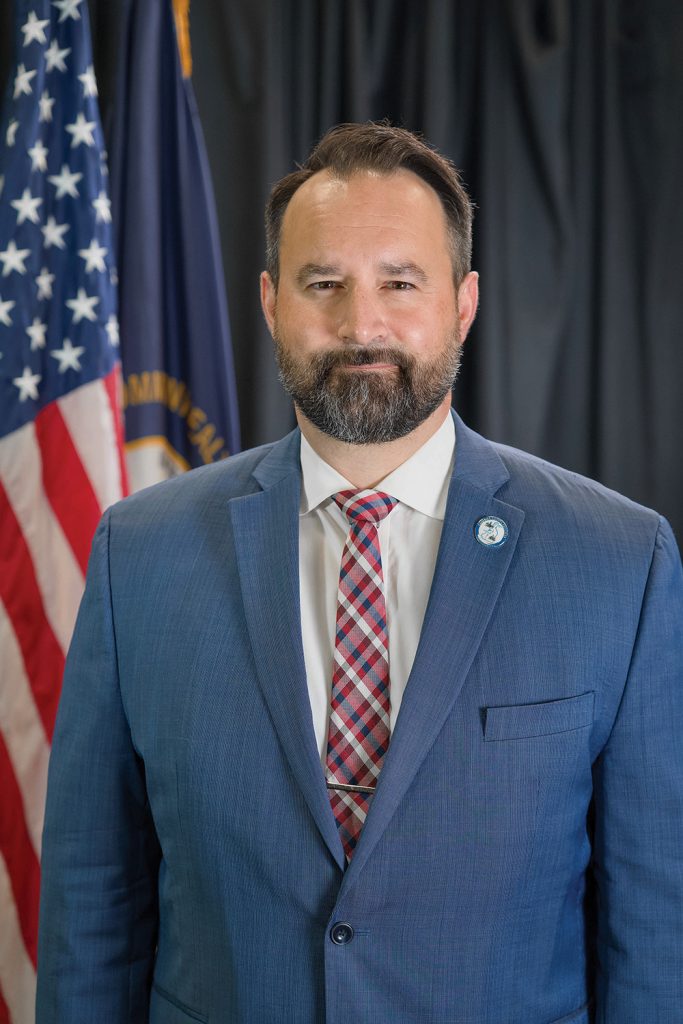
“Once the Levee was built, you saw the East Side Historic District really pick up in Newport,” says Justin Otto, Campbell County’s assistant county administrator who worked for Newport on the Levee when it first launched. “You saw other developments on the river after that, including The Banks on the Cincinnati side and Covington’s riverfront redevelopment. I feel that the Levee was really the first time we collectively said, We can do this.”
Campbell County has 15 different municipalities, with Newport the largest. The county prioritizes assisting all cities with incentives for businesses and developments. “The relationship between Newport and Campbell County is that all economic development projects start at a local level,” says Otto. “The city takes charge and has the vision, but when they need assistance or incentives they come to us.”
Just to the west of the Purple People Bridge you’ll find Festival Park and then a tad further west, at the confluence of the Licking and Ohio rivers, General James Taylor Park. When not occupied with festivals, programmed by ColdIron Events (which the Cincinnati Regional Chamber recently acquired), Festival Park can feel rather lonesome and empty. Greenery is scarce at the unassuming stretch of asphalt and concrete, other than hillside grass. General James Taylor Park features a bit more opportunity for engagement with benches, picnic tables, and a playground. It also has direct proximity to the massive Ovation development.
“We don’t want to just do one-off projects here and there to beautify the Newport riverfront, we really are looking for a coordinated strategy,” says Willis. “We want more seamless connection between the riverfront and Newport’s residential areas, including Ovation. The official scope of our riverfront project is going to be a $16 million investment running from where the old Fourth Street Bridge was on the Licking all the way to the Purple People Bridge.”
That investment allocates $8.5 million for a design-build agreement to overhaul Festival Park and $7.5 million to refresh James Taylor Park. Funding comes via multiple sources, including grants from OKI and the state of Kentucky as well as direct Newport funding.
“We’ve talked for decades about revitalizing and revamping these parks, and it’s exciting to see it all come together at once,” says Willis. “Festival Park has been home to Newport’s festivals for decades and that will continue, but instead of it being a gravel lot it’s going to be a beautified green space with a multi-use path throughout. It’s a great example of a public-private partnership and that’s unlocking multiple funding sources.”
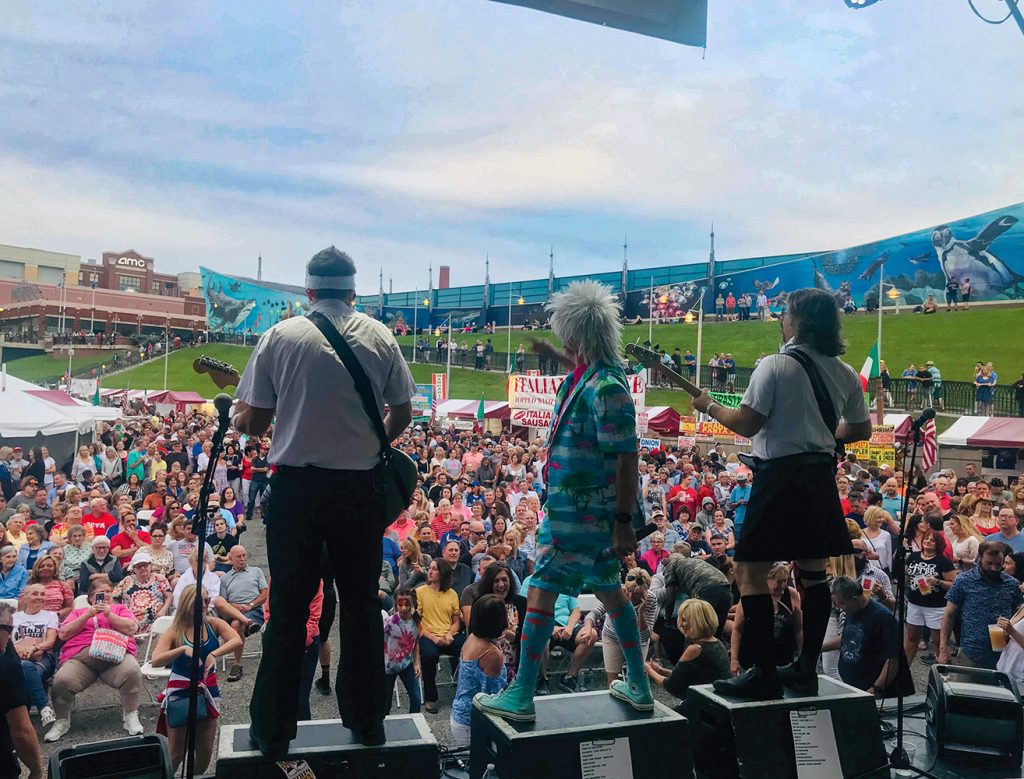
Festival Park’s overhaul is estimated to take about 18 months to complete. Newport led a number of community engagement sessions with local constituents to get their perspective on how these parks should be reimagined.
“Costs are always the top prohibitor when it comes to these things,” says Willis. “But in terms of how our communities are connected to the riverfront and what people wanted to see in the riverfront, the message that came through those sessions was that people wanted the parks to feel like a place where they could go enjoy as a community space, not just a place where festivals can set up.”
Guidugli agrees. “The green space, the investment in trees, and the beauty that occurs on the Cincinnati side of the river is finally going to be matched from Newport,” he says. “We hope that at the conclusion of these projects we’re going to hear that our riverfront parks collectively between Newport and Cincinnati are the best walking and cycling environment in the country. We’re on our way.”
The transformation aligns with Riverfront Commons, the Southbank Partners project aiming to unite Northern Kentucky’s riverfront communities. The 20-mile paved riverwalk stretches from Devou Park to Pendery Park and touches the cities of Bellevue, Bromley, Covington, Dayton, Ft. Thomas, Ludlow, Newport, and Silver Grove. The project’s goal is to connect these communities and bring more visitors to each.
“Newport ’s riverfront is a big chunk of that trail system,” says Willis. “It should come online a little bit before, but around the same time as, the Fourth Street Bridge is completed to reconnect Newport over to Covington.”
The Fourth Street Bridge was demolished in early March. As part of its $100-million replacement project, slated to be completed in 2028, the new bridge will feature two driving lanes in each direction as well as a 12-foot-wide path for bikes and pedestrians.
“It’s going to dramatically improve our connectivity, walkability, and cycling,” says Guidugli. “The idea is continuous improvement of all of our assets and investment, but not doing it alone as the city. The state is heading up the Fourth Street Bridge. We’re adding enhancements, but they’ve taken over the entire expense of that project, which is significant.”
The Ovation development is one of the largest mixed-use develop-ments currently underway in Kentucky. Billed as a 25-acre waterfront resort, it’s from the Corporex real estate development firm headquartered in Covington. Across the five blocks that comprise Ovation are MegaCorp Pavilion, three condominium buildings collectively called the Board-walk residences, a Homewood Suites by Hilton, a Class A office building, plaza-level retail, two bars, and a St. Elizabeth’s Physicians office.
“What’s come out of the ground is amazing, and there is so much potential still to come,” says Guidugli. “These are brand new concepts that weren’t available in our riverfront footprint, and it all sits on the pedestal of parking. The area around it isn’t even halfway complete to its potential, and there will be new projects announced soon.”
A Residence Inn by Marriott from local developer Keystone Hotel Groups is being located be just south of the Ovation development on Central Avenue. A new apartment building at the former World Peace Bell site at Fourth and Monmouth streets will break ground in the fall. Further south, Norwood-based developer PLK Communities (Factory 52) is transforming the long-vacant Newport Steel industrial site into a 342-unit community of townhomes and apartments. The city of Newport approved a $100 million industrial revenue bond for that development.
“Initially PLK was going to include a commercial aspect and a resident aspect, but we pushed a little bit to have more residential density,” says Willis. “It’s going to bring a lot more residents to the neighborhood and more people who are wanting to spend money at our businesses in Newport, so we’re just really excited.”
While the next several years will transform the face of Newport, Guidugli hopes his city’s spirit and sense of community remain constant. “None of it happens without our residents, our businesses, our staff, our community partners, and all the volunteers helping shape our future,” he says. “We work as a team on all fronts, and I think that’s what makes Newport a place businesses want to invest in and residents feel connected in. I think our best days are ahead of us.”