

It’s a Saturday evening in May. Pilar, a rum-forward Ernest Hemingway-themed bar on downtown’s Court Street, is thrumming with an eclectic crowd: some pre-game FC Cincinnati fans, a long-haired pirate-esque man with a laptop at the bar, a young couple with a baby on the patio, and two fiftysomething men perched casually in the open-air window frames who could have just stepped out of a Key West open-mic night.
Reggae music hums in the background. The bowels of a wooden sailboat hang over the bar (a bit precariously) and are draped in fishnets. Candles flicker at the corner tables, inviting the type of brooding conversation Hemingway himself might have indulged in after a few drinks.
The bartender greets me with a warmth that shouldn’t be unusual but nonetheless strikes me as refreshing. I order a lime-and-grenadine ditty that tastes like sunshine and seabreeze. I am utterly transported to the surf and sensibilities of Hemingway’s tropical paradise.
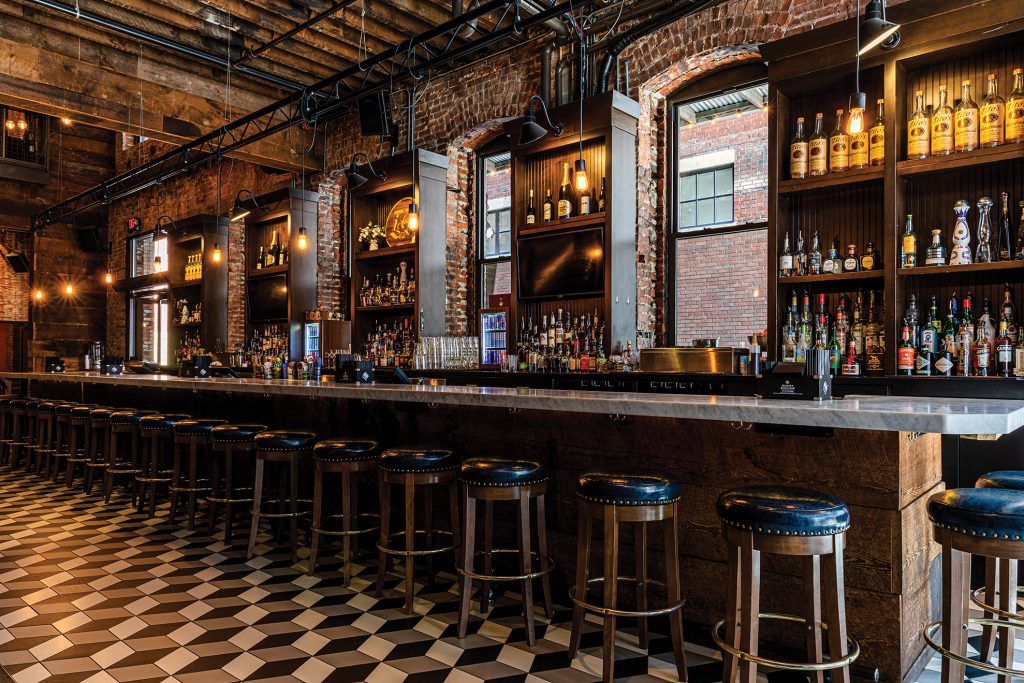
This vibe, of course, isn’t by accident. The colorful monkey wallpaper and weather-worn walls walk a delicate line between authentic and caricature, exactly as it was intended—as is every drinking hole in the 4EG family.
Unique, well-designed bars have become a hallmark of the 4EG group over the past three decades. Iconic spots like Igby’s, Japp’s, and The Lackman are household names for young and older professionals alike, while newer bars such as Over-the-Rhine’s Nice Life and Rosedale attract the next generation of social seekers.
But 4EG’s success isn’t built on good design alone—or even creative cocktails, market savvy, or capital capacity. It’s about something much simpler, yet much more challenging: the art of hospitality.
Impressive as Pilar’s tropical vibes are, it’s one simple detail that could have easily been glazed over that’s most notable: a bucket of free ponchos on the bar. The sign reads Need one, take one.
Rain had been drowning the region for days, and this subtle kindness is the artful mark of a thoughtful host. It’s the signature of a proprietor who truly understands the art of hospitality. Perhaps it is that ethos, more than any market timing or providential investment, that’s kept the 4EG family of bars largely alive and well over the past 30 years.
Pilar is one of 13 Cincinnati bars currently under the 4EG umbrella, which also includes seven bars in Chicago, two in Columbus, and one in Naples, Florida.
The group has evolved into a bit of an anomaly in the hospitality business. Not only did it survive the turbulance of Covid, but in a post-Covid era when many bars are still struggling to rebuild their core clientele, 4EG is not only thriving but aggressively expanding across geographical markets and product verticals.
While there’s no single ingredient that makes the team’s hospitality successful, a few foundational tenets have kept the group grounded. But before we get there, we have to understand how 4EG got here. That story begins in Oxford, Ohio.
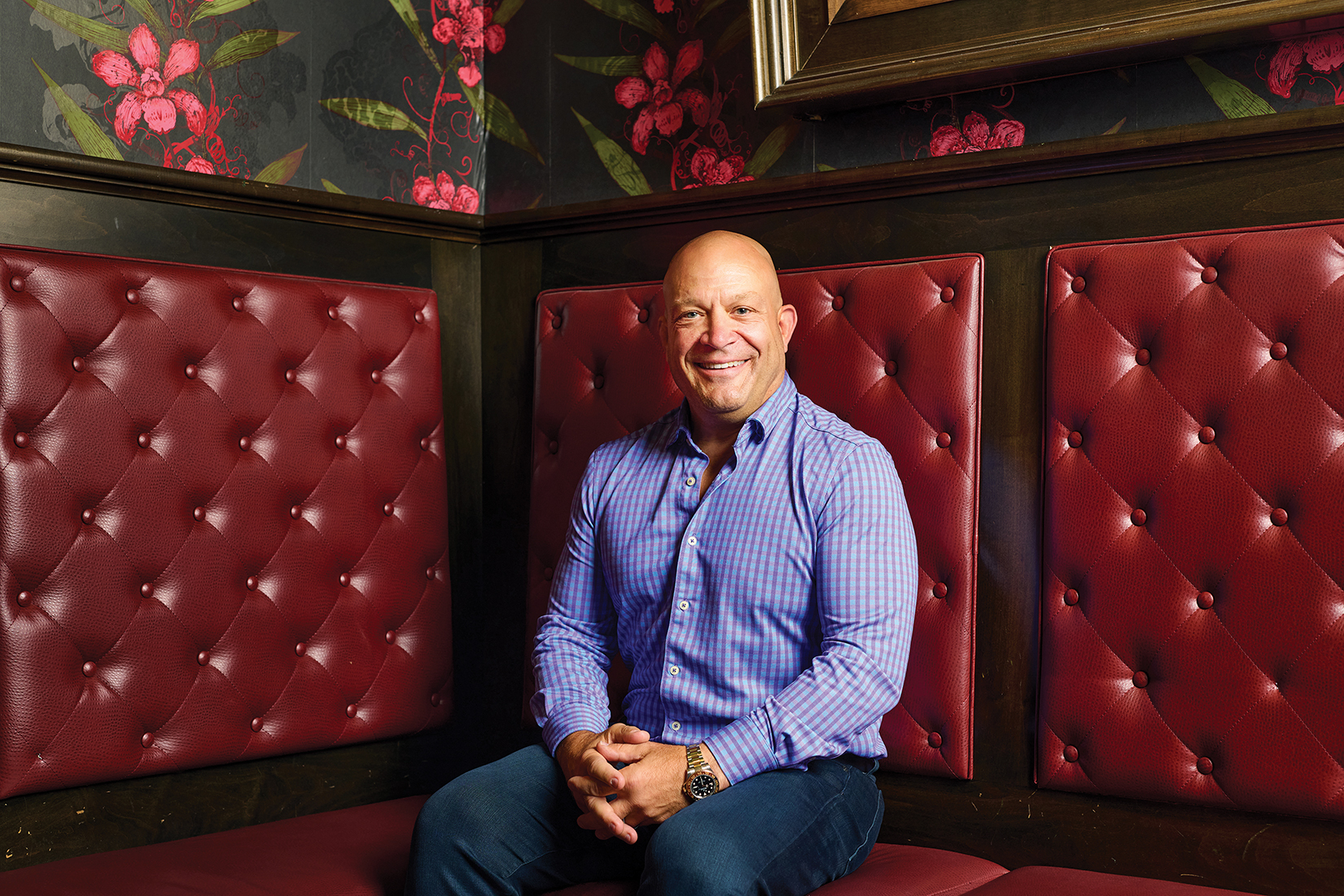
(Pictured at top: Bob Deck at The Righteous Room. Photograph by Chris Von Holle)
A couple of years after graduating from Miami University, a few friends floated a question among themselves: Could we open a bar? Bob Deck, Ben Klopp, and David Halpern had been bartenders in Oxford while in school, manning the doors and drafts at then-iconic haunts like First Run and Skipper’s Pub & Top Deck. The part-time bar jobs were fun and flexible at the time, but in hindsight they were laying the foundations of good business acumen.
“We took bits and pieces from everything we learned, the good and the bad,” says Deck, one of three man-aging partners of 4EG. “To this day, we always let our staff comp whatever they want. We’ve never not allowed them to do that. It’s just one of those things, from us working in bars for so long, to recognize how much better it would be for them and the customer experience.”
While Oxford’s lively High Street had provided good gigs in college, the troupe of twentysomethings weren’t sure they could make bar life into a business. Klopp had been a finance major, Halpern had a sociology degree, and Deck was a practicing chiropractor in Charlotte, North Carolina. None of them expected to embark on a career-long journey into hospitality.
“We saw it as a way to pay the rent and have fun,” recalls Klopp, a managing partner who helped launch Chicago’s aliveOne bar in 1996. This was before “4EG” had established itself as an entertainment group. At the time, the bar was intended to be a one-off project. “The plan wasn’t to get into the bar business for 30 years,” says Klopp.
Come 2001, now with Deck on board, 4EG opened a second aliveOne in Mt. Adams and took over owner-ship of Mt. Adams Pavilion. Even at that point, “we had no intention really that it was going to set out to be 4EG or this big company,” says Deck. “It was really about opening up small, individual, very cool bars that we knew our friends and the neighborhood would enjoy.”
In fact, much of 4EG’s early customer base consisted of fellow Miami grads who had transplanted to Cincinnati and Chicago post-graduation, he says. In those early days on shoestring budgets, the ownership crew rolled up their sleeves to get the work done, purchasing dilapidated bars and zhuzhing them up to become their own. They hand-painted the walls and scoured second-hand light fixtures. At night, they took turns managing and operating the establishments.
Word spread. People came. One bar turned into two. Two bars became three. Within a few years, those “one-offs” were officially a network of nightlife destinations. “Every one of them was unique,” says Deck. “We built them for the neighborhood they were in.”
Eventually, the owners made their first leadership hire outside of bar staff: an event coordinator to help market and manage larger events. The portfolio was expanding, but the operation still felt largely home-grown. Deck and Klopp oversaw the growth of the Cincinnati locations, while Halpern helmed expansions in Chicago, which were slightly outpaced by the buzz of Cincinnati’s urban-core growth. Then, everything changed when 3CDC entered the conversation.
Call it kismet or just lucky timing, but the 4EG guys had hit their groove at the same moment development juggernaut 3CDC was looking to revitalize downtown Cincinnati’s central business district. Around 2007, the nonprofit organization approached 4EG about a vacant location across from the Aronoff Center for the Arts.
It was a risk for both parties: 3CDC had a big vision, and 4EG was still a relatively scrappy group of young professionals. “No normal bank was going to fund that,” says Klopp.
And yet the two groups took a chance on each other. For 4EG, it was their first foray into a ground-up entertainment concept that relied on architects and construction companies. “We fell in love with that because you’re creating stuff from a blank slate at that point,” says Deck.
The vacant space became The Righteous Room, a concept catering to the downtown after-work business crowd. “I wanted to have the best happy hour in the city,” says Deck. Seventeen years later, The Righteous Room is still known for luxe leather seating and half-price drinks 4-7 p.m.every weekday.
Quick on its heels came The Lack-man in 2010, a gamble in then-largely undeveloped Over-the-Rhine but a golden opportunity nonetheless. Its location at 12th and Vine streets was prime real estate in what would eventually become a buzzing hub of high-concept restaurants and bars. Once again, the vision for this new bar was to align with the burgeoning population of the neighborhood—casual enough for nearby apartment renters to pop down for a drink before dinner but also classy and quiet enough for a tete-a-tete between professionals.
Soon after, in 2012, came Igby’s on Sixth Street downtown, designed to complement David Falk’s Nada around the corner and Boca next door, which was followed immediately by Sotto in the space below Boca. Notably, those Boca Restaurant Group restaurants still experience month-long waitlists for reservations, reflecting a kindred spirit of hospitality that propelled 4EG.
Over the next few years, the wins kept coming for 4EG, with expansions into “lifestyle” centers like Liberty Center’s The Roosevelt Room in 2017. Before long, 4EG had grown from a band of fraternity brothers to full-scale entertainment empire. Then Covid hit.
Like every bar and restaurant, the Covid pandemic sent 4EG spiraling. There was the immediate shutdown, of course, but there was also the on-going and ever-changing restrictions across three different states—Ohio, Illinois, and Kentucky—that intensified an already herculean challenge to survive.
“In Covid, what saved us is we were very decisive,” Klopp says. The leadership team met via Zoom every morning and scavenged for every loan and grant available, divvying up research and application processes to cover as much ground as possible.
“It was every day waking up and having conversations about how to get through the next day,” says Deck. Barriers were erected between tables. Mask and social distancing protocols were communicated to staff. To-go drinks were offered to customers. The founders stayed positive, buoying spirits among the furloughed staff even when they themselves felt like they were drowning. “They all were fearful,” Deck says. “You’re the person that they look up to. You’re their employer and the leader, and you didn’t have all the answers other than just trying to talk to them about staying positive.”
It was when bars were allowed to re-open, even if only as shells of their former selves, that the 4EG leadership team fully realized the strength of their staff—and not just their staff, but their collective culture. The culture had kept the business going, not just for its customers but for its employees. Despite the turbulence, many of the 4EG staff stayed.
Even before Covid, 4EG had established a culture that cared about its workers, knowing that employee satisfaction would flow into quality customer service. Unlike most bar conglomerates, 4EG offers staff a 401(k) plan and health insurance along with flexible part-time work for students paying their way through college. The owners have also designed upward career paths for those with families to support and aspirations to advance in the hospitality industry.
That said, Covid caused casualties to the 4EG portfolio. Its Keystone Bar and Grille locations in Hyde Park and Covington collapsed. The extra pressure of food—and all the staffing and storage required to keep food service up to par—just wasn’t worth it in 4EG’s post-Covid plan. In fact, that realization was a silver lining in an otherwise trying season. “We realized what we do best and who we are, and that’s where we set our sights on growth,” says Deck.
To this day, almost none of the 4EG bars serve food. Deck notes that colleagues in the food business still struggle more in the post-Covid world due to frequent fluctuations in food pricing. That’s not to say 4EG will never serve food, but for now the company finds steadier ground in sticking to its strengths in bars.
In the end, hospitality won for 4EG. Or rather, hospitality is winning. The leadership team continues to be dogged about treating team members with respect and giving them ownership in the collective success of representing a company they can be proud of. It all harkens back to those lessons from undergrad at sticky-floor bars in Oxford—every member of the 4EG founding team remembers what it’s like to be on the other side as hourly staff working for tips.
“Hospitality is always just the business of making people feel good,” says Klopp. “When people come in, they just want to be treated well.”
Today’s bar scene is shifting yet again, and not just for 4EG but for everyone in the drinking industry. According to alcohol marketing agency OhBEV, Gen Z is the most alcohol-aware generation to date. Generally speaking, Gen Z is highly attuned to wellness trends such as clean eating, fitness, and mental health and recognizes the potential negative effects of alcohol on long-term mental and physical health.
For many, adapting “sober-curious” seasons have become trendy. Heavy drinking is no longer viewed as rite of passage; rather, self-awareness and individual health priorities are viewed as aspirational. Studies also show that because Gen Z was raised in a decade of economic uncertainty they’re more fiscally aware than previous generations, making their spending habits more tightly controlled.
The bottom line: When Gen Zers do imbibe, they’re highly selective about where and how they spend their dollars. “After Covid, we saw with this new generation that they’re more into the experience,” Deck confirms. “If they were going to go out and spend money, they wanted to be intentional about it.”
To adapt to these changing behaviors, 4EG has added full-scale mock-tail menus designed with the same intentional curation as a traditional cocktail menu. They’ve also doubled down on selections of THC beverages and non-alcoholic beers. And 4EG recognizes now, more than ever, the power of providing a holistic hospitality experience.
Going forward, 4EG is pouring heavily into two brand lines—Beeline and The Roosevelt Room—that do well in suburban lifestyle centers such as Liberty Township and Easton Towne Center in Columbus. The company’s fourth Beeline location is currently under construction in Deerfield Township.
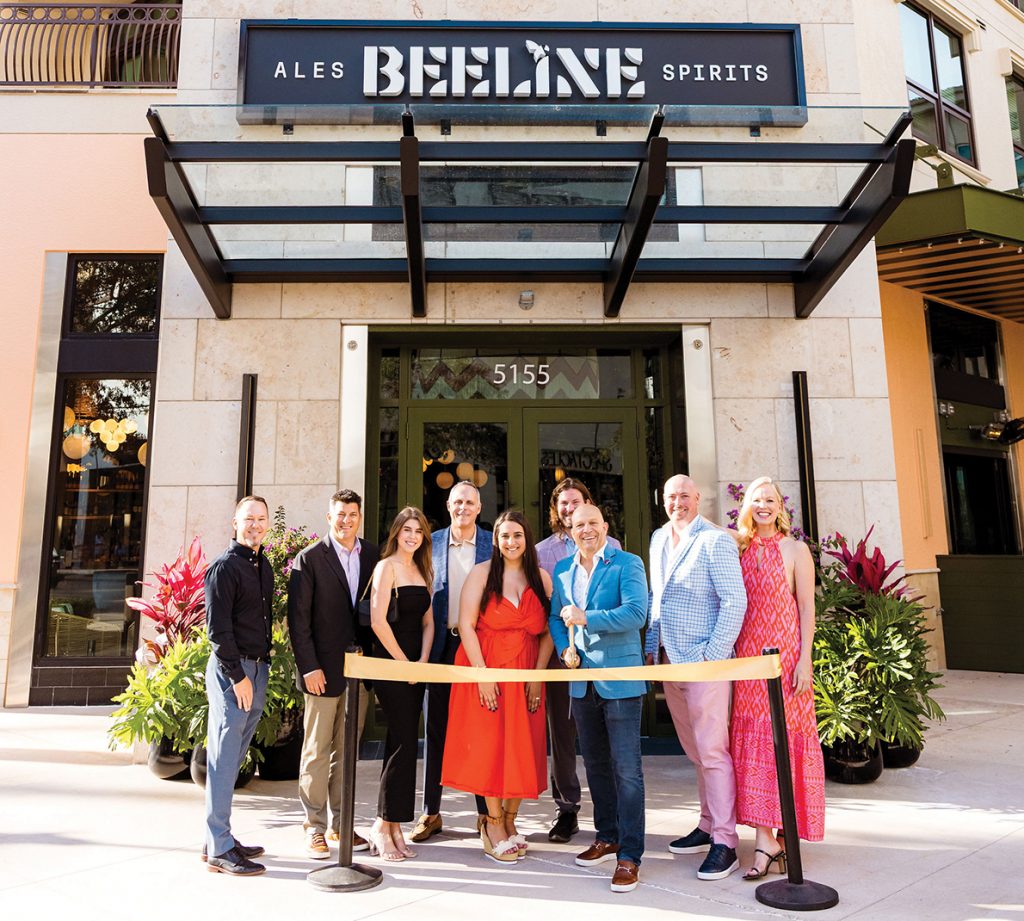
4EG established a test stake in the Florida market last year with the opening of Beeline-Mercato. It was a fortuitous connection made through the large commercial developer North American Properties, which owns Newport on the Levee, who foresaw 4EG’s Beeline concept as a perfect fit for its new development in Naples.
The 4EG Chicago arm remains largely dedicated to high-end urban neighborhood haunts primly placed in desirable alcoves like Lincoln Park, Wicker Park, Logan Square, and Bucktown. They aren’t nightclubs per se, but nor are they dives. “Just well-designed, comfortable, friendly neighborhood bars with a great cocktail program,” says Klopp.
Regardless of market trends and consumer behavior, 4EG’s non-negotiable tenet will always be the genuine spirit of hospitality. It’s the warm greeting from the bartender, the thoughtful stool selection at the bar, and the intentionally designed menu that’s both fresh and familiar.
“We have to be that place they pick and know they’re going to have a good time,” Deck says. “When they do have a drink or two with us, we want them to leave with a better experience than when they came in.”
Sometimes, successful hospitality is as simple as a bucket of ponchos on the bar.