


Most people have been affected by a wonderful or wandering nurse at some point in their lives. Nurses are arguably the glue that holds the U.S. healthcare system together, as we found out during the pandemic when there weren’t enough skilled nurses to go around. Since then, Cincinnati’s bustling and expanding nurse education scene has seen exponential growth, from a surge in student interest to wider degree offerings and impressive new facilities.
The region’s hospital groups are collaborative and competitive all at once, with programs vying for new candidates starting in high school while also trying to capture the attention of busy working adults looking for a career change. Programs are considering the role of AI in a changing technology landscape, training nurses for a future that none of us can fully visualize yet and to ward off burnout before it happens.
There was a shortage of more than 2,400 registered nurses across Ohio in 2025, according to the National Center for Health Workforce. Burnout and the subsequent shortage have a variety of causes, such as reports that more than 68 percent of direct care nurses have experienced workplace violence. Overall, nurses are leaving the profession within the first two years at rates as high as 33 percent, according to the Online Journal of Issues in Nursing.
And yet, on a national level, nursing schools can’t find enough spots for those interested in the profession. Between 2024 and 2025, more than 90,000 qualified applications were turned away due to operational limitations and faculty shortages. Local schools—including public, for-profit, and private nonprofit—are answering the call, pouring resources into new facilities, larger education staffs, and attractive new programs.
Here are a number of highlights in the robust Cincinnati nursing school ecosystem.
[Illustration by Chanelle Nibbelink]
Public Universities
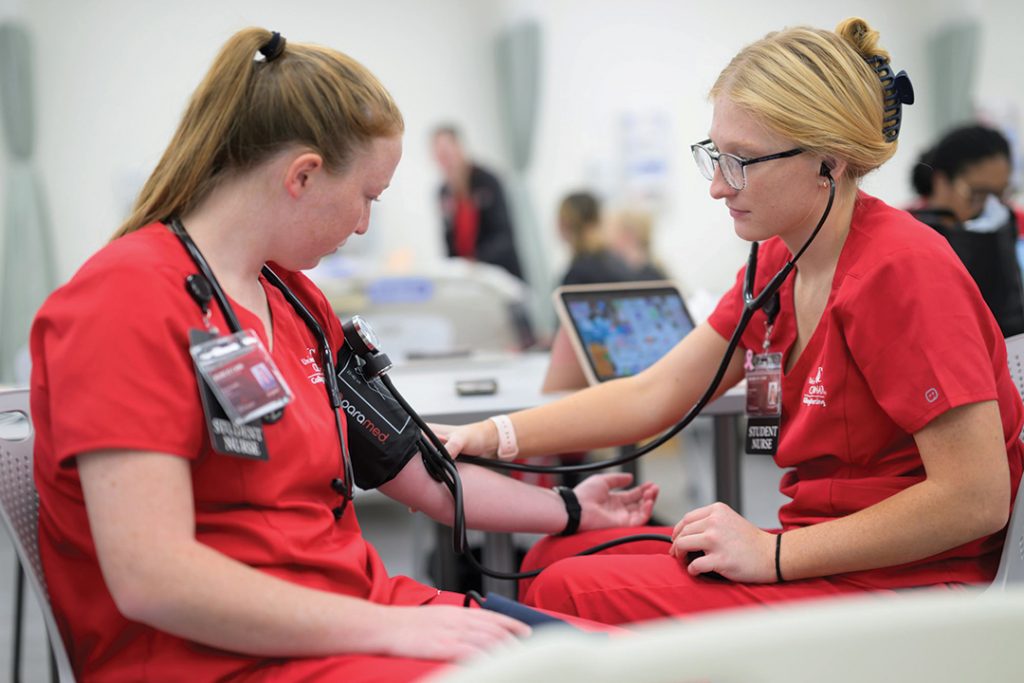
University of Cincinnati College of Nursing
BSN plus post-undergraduate, including MSN, PhD, and DNP; also offers an online master’s in nursing.
In May, UC’s College of Nursing announced a $105 million renovation to move the program from its current space, Procter Hall, to a modern, updated version of Holmes Hospital nearby. UC expects fall 2026 first-year enrollment to grow by a third, or roughly 100 additional students, with applications up 23 percent. Dean Alicia Ribar of the UC College of Nursing says over the last two years they’ve increased enrollment by 112 percent, or about 125 students.
“Holmes Hospital will almost triple the size of the teaching and education space that we currently have to be able to accommodate the increased numbers we’re admitting,” says Ribar. “We’re designing the space to meet our current needs, but we’re also beginning to design the space to think of 20 years from now. We’re trying to make more areas that are flexible, kind of white spaces that we can utilize virtual reality in but can also be turned into something else in the future should that technology be developed.”
Ribar says since the original Holmes used to be a functional hospital, it’s a unique opportunity for realistic training grounds. “We’re really trying to lean into the fact that there are some spaces that are already designed that we’ll be able to incorporate into student training that the students may not have otherwise seen,” she says.
UC Health and multiple other schools work with The Health Collaborative, which many healthcare leaders mentioned as a critical part of connecting and partnering with local hospitals for nurse training. “It’s going to be imperative that schools like the University of Cincinnati, as well as all of our partner schools, come together to figure out how we can really address the shortage,” says Ribar.
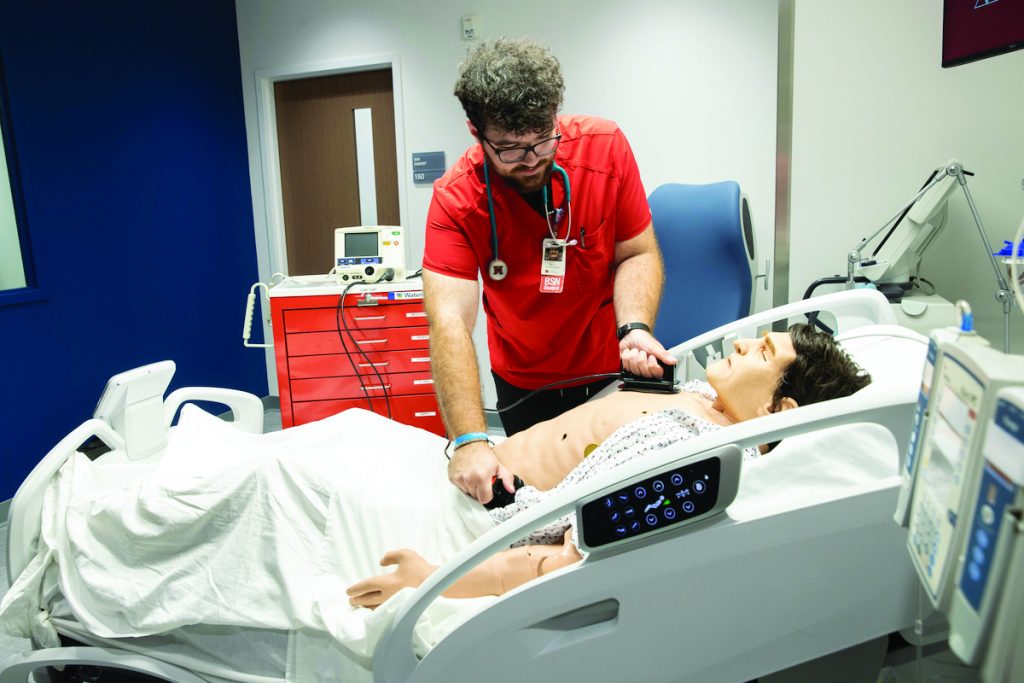
Miami University Department of Nursing
BSN, MSN, and DNP; the “One Plus Three program” offers high school students a year of nursing at county career centers to shorten time toward attaining their BSN.
Miami University opened its Nursing Innovation Hub in 2022, featuring four high-tech classrooms, four high-fidelity simulation labs, and a multi-bed skilled nursing area. Miami also tries to plant seeds of interest early, collaborating with Butler Tech Career Center and Warren County Career Center to allow high school seniors to take Miami-taught nursing courses. From there, they can take a three-year BSN instead of a four-year route, according to Ande Durojaiye, vice president of strategy and partnerships. “When completing a nursing program is a question of affordability or access, we’re eliminating all that,” he says.
Durojaiye says Oxford’s campus alone has exceeded 5,000 applications in the most recent cycle for nursing programs, and regional campuses at Hamilton and Middletown continue to grow. At the center of it all is a newly opened Cleveland Clinic Health Sciences Building, where nursing programs have been offered since 2023.
Having the physical space and equipment “state of the art” and highly realistic, through partnerships with healthcare systems such as TriHealth in that building, helps students work in a setting that closely mimics what they’ll see post-graduation. “We have an internal home-grown system to help students learn how to input information, keep track of meds and patient records, developed by one of our staff members,” Durojaiye says. “When they go out to the hospitals, they are ready to hit the ground on day one.”
Cincinnati State Bethesda School of Nursing
BSN and Practical Nursing programs.
Cincinnati State now has a complete nursing pathway—perhaps the only such pathway in one location in the region—from nurse aide (STNA) to licensed practical nursing (LPN) to registered nurse (RN) to bachelor of science in nursing (BSN), according to Bonnie Smith, dean of the health and public safety division, which includes nursing.
Nurses who are already working sometimes head back to school for a higher degree. Cincinnati State has turned its attention in recent years to offering an RN-to-BSN completion program for that reason. “Registered nurses move on and complete their course of study in three semesters using our eight-week format, so we’re in candidacy with that program and should have accreditation approval in October,” says Smith.
This expansion is partially due to a $1.5-million grant from Hamilton County through the American Rescue Act Plan to increase enrollment by more than 100 students each semester, which Cincinnati State has done, in addition to building a practical nursing lab. The lab has an interdisciplinary approach so that nurses learn to work alongside other medical and public safety roles, such as paramedics, respiratory therapists, and occupational therapy assistants. AI simulators can think and talk, and one even cries. “Simulator Victoria gives birth several times a semester, and there’s a toddler simulator,” says Smith.
On “disaster days,” full-scale emergency simulations from shootings to crashes help nursing students work together across roles as well. But on the bad days nurses might face once they’re in their roles, Smith says Cincinnati State wants to support them through an upcoming planned mentorship program.
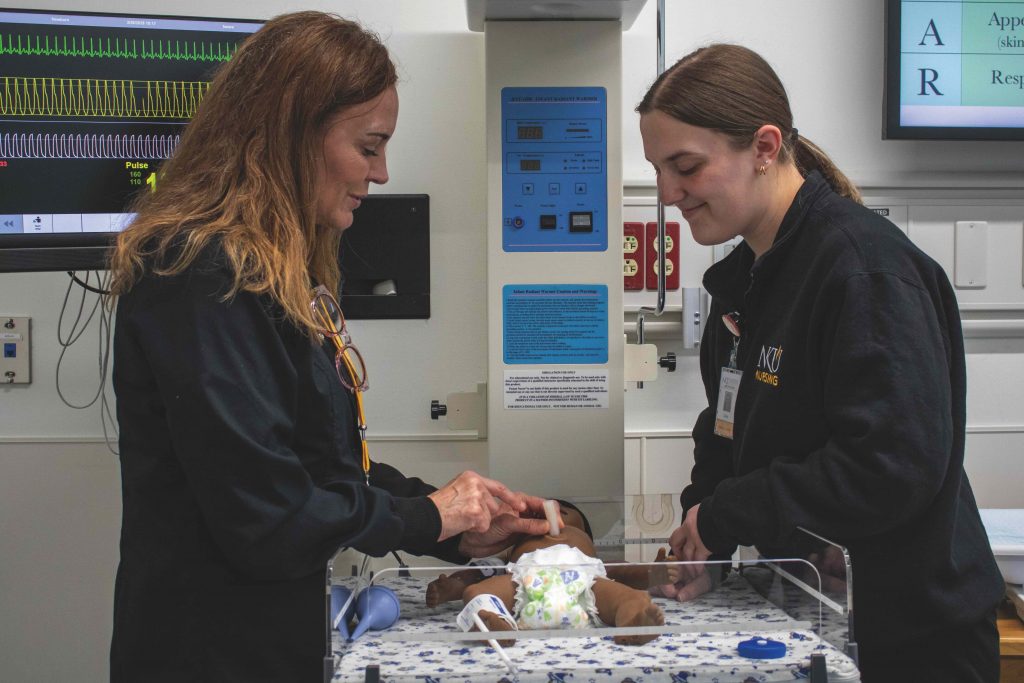
Northern Kentucky University School of Nursing
BSN and accelerated BSN, MSN (100 percent online), and DNP.
Building competency and confidence is the top goal for a young nursing workforce rising through the ranks, says Jennifer Evans, director of NKU’s School of Nursing. With tech rolling out globally at a rapid pace, her focus is on getting nurses to be “practice-ready” through an increase in faculty to support a recent curriculum change called “competency-based education.” “Some of the expansions we’re looking at right now include adding faculty across the board from the BSN, MSN, and DNP programs, one of which is a popular and competitive certified nurse anesthetist track,” she says.
NKU offers a program called the Norse Nurse Scholars Program for high-achieving high school students to have a guaranteed spot in the nursing program if they maintain a 3.0 GPA and complete volunteer work their first year at NKU. And it tries to increase the industry’s retention rate by making sure nurses have access to a variety of pathways in case they “don’t like where they’re at,” says Evans.
Private Nonprofit Schools
The Christ College of Nursing & Health Sciences
BSN and an accelerated BSN.
Nursing can make an attractive second career for those looking for a change later in life versus the typical 20-something graduate. Christ College of Nursing has been expanding to accommodate those students through a nights-and-weekend pathway. “We’re trying to fill a gap for people who are working and looking for a second career, and there has been a lot of interest in that pathway,” says Mary Page Dalrymple, nursing instructor and program chair.
Programs offering expedited courses are also helpful to this cohort. “It used to be that students wanted the summers off, but now they want to get a degree much faster,” says Alicia Cole-Harmon, BSN program chair and assistant professor. “So interest in our three-year year-round program has grown, and the accelerated BSN has doubled in size. We have plans to potentially roll out nights and weekends for accelerated students too.”
Burnout prevention at Christ College involves proactive education, infusing “self-care” into the curriculum. Dalrymple says the lessons include “How do you teach patient self-care? How do you take care of yourself? How do you debrief after those really traumatic experiences?”
“We recognize there is no single path to becoming a nurse,” says Amy Wutke, president of The Christ College. “As the demand for nurses continues to grow, our role is to remove barriers and create more opportunities for students to enter the profession and serve our communities.”
Xavier University College of Nursing
BSN and graduate/accelerated tracks.
“When we talk about nursing here at Xavier, I think the two words that come to mind are growth and evolution,” says Terri Enslein, interim dean of nursing. XU has seen a 44 percent increase in freshman deposits for the nursing school and a 9 percent year-over-year increase in graduate programs. An accelerated second-degree master’s track recently expanded its cohort size by 30 percent, and they’ve added a third nurse practitioner track in adult gerontology primary care.
Beyond numbers, nursing at Xavier focuses a foundational Jesuit value called Cura personalis, or “care for the whole person.”
Combatting nursing career burnout starts with that value during school, Enslein says. “We have smaller class sizes and more personalized focus and attention that sets us apart,” she says. A popular elective course in the undergraduate program is called “Success Over Stress” and specifically teaches recognizing the signs of burnout and knowing how to respond.
Good Samaritan College of Nursing & Health Science
AASN and RN-to-BSN.
Partnerships with local hospitals aren’t just talk; in some programs they directly lead to more money and opportunities for students. Good Samaritan’s College of Nursing, for examples, partners with TriHealth and offers tuition discount for working in the hospital as well as mo tuition reimbursement if they stay after graduation and work in TriHealth, according to Marla Silliman, vice president of corporate strategy.
Sherri Joyce, dean of academic nursing, says Good Sam tripled its enrollment post-COVID, started an LPN program and a surge-tech program, and took over a RadTech program from Xavier. “Since the pandemic, we’ve had a very intentional strategic focus on how we grow the workforce,” she says.
One of the college’s core offers is a “two plus two” model that allows students to sit for RN licensure after two years before progressing with two more years of education to BSN, while also making a nursing salary through the last two years. “It’s a unique niche in the community,” says Joyce. “You can still obtain a bachelor’s degree in four years.”
Joyce says the market is starting to level a bit, noting that TriHealth used to have 1,500 in-patient nursing openings per month on average but in April had just 125 open positions. “It’s in how you recruit and retain,” she says. “Nursing is a super-human job. You have to be highly quick and proficient in the computer and highly quick and proficient in people skills and life-saving skills and math skills.”
Good Sam’s nursing school embraces AI, incorporating an AI-based learning tool “Claire” that can quiz students or answer questions. Beyond that, AI is “going to transform” nursing, Joyce says. “We’re using virtual nursing, and AI is a big tool in the hands of nursing this year and next year. I don’t know that we can fully appreciate how.”
Mount St. Joseph University School of Health Sciences
BSN, accelerated three-year BSN pathway, MSN-MAGELIN, MSN, DNP, and nursing graduate certificates.
With 100 years of educational nursing behind them as of this year, Mount St. Joseph University nursing programs offer several nursing pathways for students, from undergraduate to graduate and doctoral degrees. The university focuses on a human-centered approach to learning, encouraging patient-centric care through interactive experiences while maintaining small class sizes and hands-on learning.
Private For-Profit Schools
Chamberlain University
Three-year BSN and fast-track programs.
Entering nursing school shouldn’t depend on a twice-a year-semester change, says the folks at Chamberlain, where getting started is a possibility every eight weeks. Chamberlain chose Cincinnati after analyzing markets with the largest gaps between nurse demand and supply; this region showed a “very large gap,” along with several large health systems, according to Priya Shastri, Chamberlain Cincinnati executive campus director. “For every graduate, there are six open positions,” she says. “Sometimes folks understand physician shortages for obvious reasons, but nursing shortages can impact patients even more.”
So Cincinnati is becoming Chamberlain’s 25th location, beginning with students who started August 31 in Kenwood. The school’s national growth has been nearly 6 percent year-over-year in the number of nurse practitioner graduates betwewen 2025 and 2026. The sharpest gains were in the Psychiatric-Mental Health NP track, which grew more than 25 percent year-over-year; the specialty is tied to one of the country’s most acute behavioral health shortages, Shastri says.
Once the Cincinnati program is built out, capacity will be around 460 students, who will have options for evening and weekend classes or a fully online program. “The majority of the workforce tends to be younger, newer mothers coming back into the workforce wanting a career, so the idea is to be flexible so we can cater to everyone,” says Shastri.
An advantage of a brand-new facility opening is “state of the art” technology and simulations. “I’m really excited that our students are going to get a Google Cloud AI certification along with their nursing degree,” she says. “It’s a solid career path full of opportunities where you can really help people.”
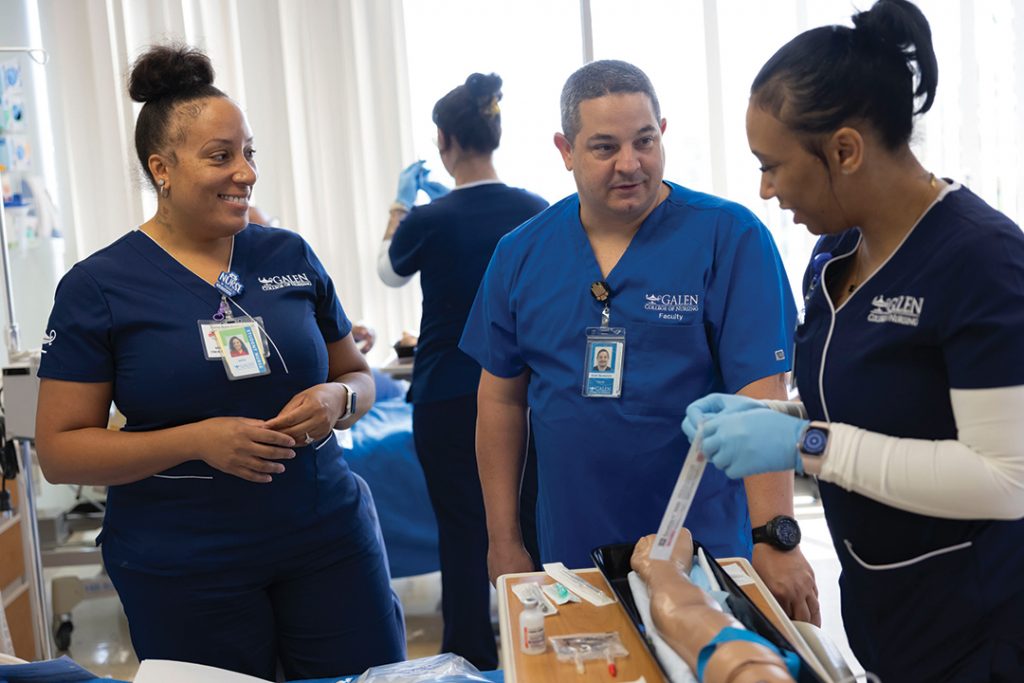
Galen College of Nursing
Three-year BSN, LPN/LVN-to-ADN, 18-month fast path to BSN (18 months), and online options.
Since 2007, Galen has been a mainstay for Cincinnati nursing students, now considered a “legacy campus” among the nationwide Galen programs that launched in 1989. This means they’ve forged a long history of clinical partnerships, says Candice D. Elmore, dean and program administrator. “We don’t take those relationships lightly.”
An advisory committee meets with partners from Mercy and TriHealth to Kettering, Premier, Christ, and UC to determine what nursing skills training would best serve their needs. Elmore says that a few years ago they determined together that nursing students should do 12-hour clinical days, as nurses do, to more closely mimic the profession. “So when they graduate, they understand the expectations, and they’ve been building with stamina in mind that this is what the normal healthcare environment looks like,” she says.
Elmore is seeing a decrease in interest in bachelor’s degree enrollment across the city, and the associate degree is the “fastest growing track” because both programs take the same exam, so getting the RN license faster means more nurses “are readily available at the bedside.”
Technology can have a negative effect on students if they use it to bypass learning real-life skills. “Every time you discover one way students may be using AI or tech to get ahead, we have a constantly evolving process to deal with that,” says Elmore. “That tells you how fast we have to overturn to keep the profession the most trusted profession. Our goal is to train qualified, compassionate nurses who can keep people safe and alive, and there isn’t enough AI in the world that can do that. As a nurse, you have to be 10 steps ahead.”
The average age of an associate’s degree student at Galen is 29, showing the popularity of nursing as a second career. Elmore says the school is looking to “give people an opportunity by looking at more than GPA when evaluating applicants.”
Hondros College of Nursing
LPN, RN, and direct-entry ADN.
With eight campuses across Ohio, Hondros College of Nursing provides four start dates each year, ensuring it’s never too late to start a nursing career. The college has been in existence since 2006 and offers classes during the day, evenings, and weekends, helping students balance family and class time. Additionally, the college offers a “Learn and Earn” Ladder approach to education, giving students the opportunity to earn income as they progress through their education.
Beckfield College
DPN, AASN, BSN, and RN-to-BSN.
Beckfield College has been a staple in Ohio and Northern Kentucky for more than 40 years. With four nursing pathways, students are able to choose the program that best fits their career goals. The college utilizes clinical education, simulation learning, and nursing labs to prepare students for careers.
Arizona College of Nursing
Three-year BSN.
Arizona College of Nursing has three campuses across Ohio, offering a combination of virtual and hands-on learning, with evening classes available for general education requirements. There is no waitlist, and students have the ability to work through the program in three years or less, depending on eligible transfer credits. Classroom teaching includes simulation labs and real-world opportunities at partner healthcare providers.