
Cincinnati’s support for our arts and cultural institutions can be measured in any number of ways. Their annual economic impact on the region is projected to be $587 million in 2027, not counting BLINK, which alone contributes $250 million in total economic output every other year. The arts create or support more than 6,500 jobs. Cincinnati is the top-ranked Ohio, Kentucky, or Indiana metro area in the 2025 Arts Vibrancy Index and ranks in the top 20 of large U.S. cities.
Another key number is 100, as in ArtsWave’s 100th anniversary in 2027. The fundraising organization’s annual three-plus-month campaign raised $12.1 million earlier this year from more than 20,000 donors, raised primarily via workplace campaigns at 160-plus area companies. ArtsWave grants support more than 150 arts groups, projects, and individual artists in the region on both sides of the river.
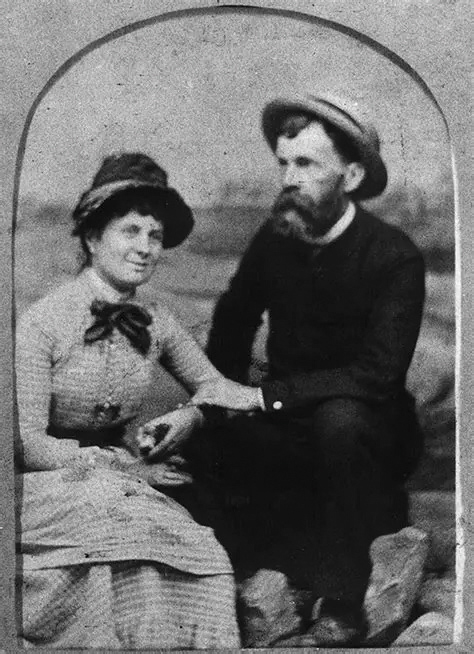
The Cincinnati Institute of Fine Arts launched in 1927 thanks to a challenge grant by Anna Sinton and Charles Phelps Taft, who would later donate their downtown home and art collection to create the Taft Museum of Art. The city’s business leaders of the day—from Fifth Third Union Trust’s John J. Rowe to Barney Kroger and William Cooper Procter—pledged their support in response. The first community fundraising campaign started in 1949 to support the Cincinnati Art Museum, Cincinnati Opera, Cincinnati Symphony, and Taft Museum. The ArtsWave name debuted in 2010, and today its annual campaign is the nation’s largest and oldest.
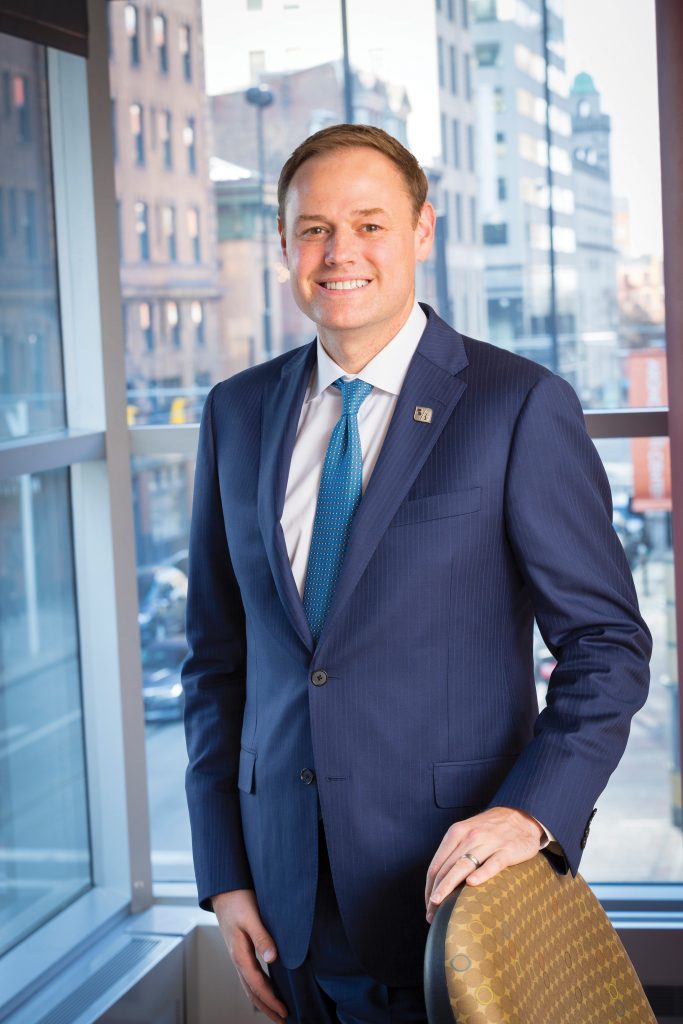
ArtsWave and Fifth Third Bank, whose CEO Tim Spence chairs the 2027 community campaign, are sponsoring the new Cincinnati Art Week October 3-10 to lead into this year’s BLINK weekend and kick off the 100th anniversary celebration a little early. ArtsWave and Fifth Third will present light installations during BLINK at the Aronoff Center for the Arts and Fountain Square, respectively.
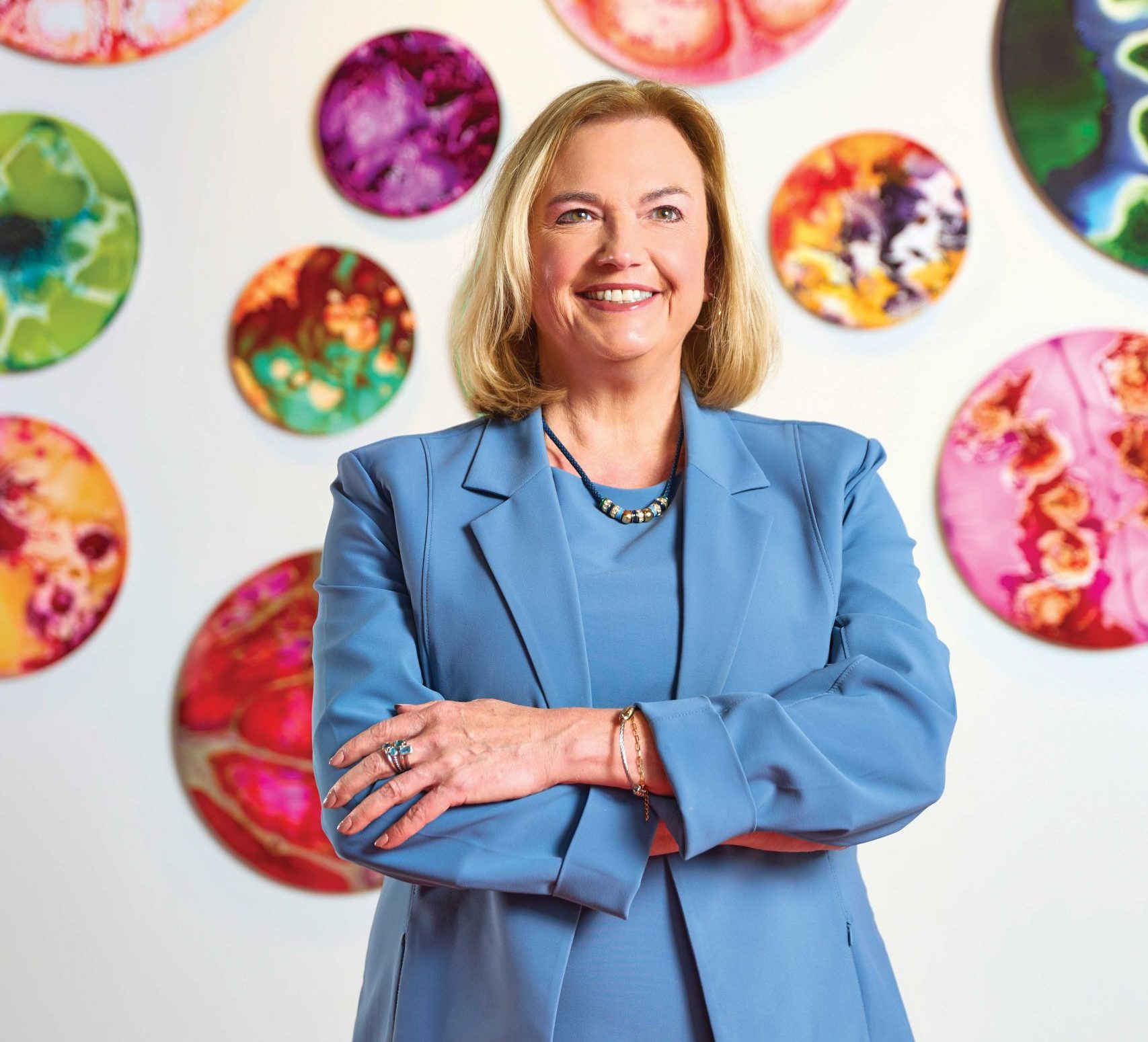
ArtsWave CEO Alecia Kintner discusses the 100th anniversary’s significance as well as new efforts to generate public support for the arts in the face of changing workplace trends.
[Photo of Alecia Kintner by Andrew Doench]
Why are you kicking off the 100th anniversary year celebrations in October?
The kickoff event, Cincinnati Art Week, is an inaugural program co-sponsored by ArtsWave and Fifth Third Bank that puts a spotlight on the fall’s two major cultural festivals in Cincinnati, starting with the FotoFocus Biennial and wrapping with BLINK. Cincinnati Art Week will have several pop-up galleries in the Over-the-Rhine area and local artist activations, artist talks, and opportunities for social interaction. It enables us to say to the community, Go to OTR during the day and enjoy the architecture, the shops, and the art, then come back in the evenings for BLINK.
It’s designed for our local community to get even more involved with BLINK, but also for those coming from out of town the week gives them something else to do. South by Southwest is a great example of what this week can be, because other producers have plugged into that music festival with film and technology programming. StartupCincy Week is the same week, so that’s an example of how content can be developed within this framework. We’d like to see more and more kinds of offshoot programming in the coming years.
How else are you supporting Cincinnati Art Week and BLINK?
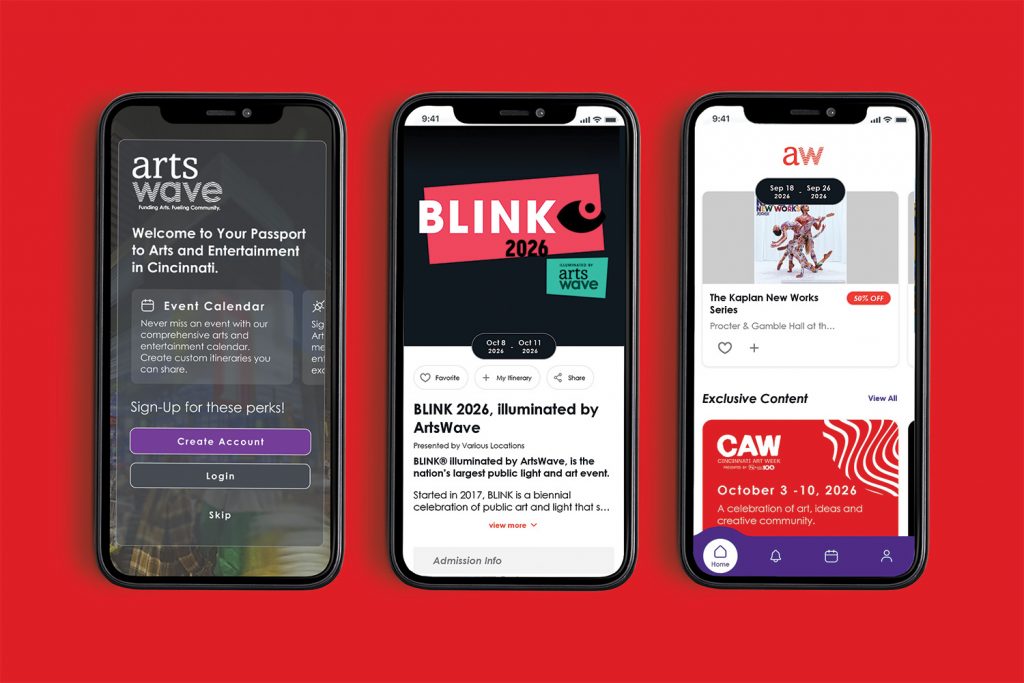
ArtsWave’s Cincy A&E app will be the guide to Cincinnati Art Week and then sort of the way to BLINK more, if you will. It’ll help you plan your experience before and during BLINK weekend and then afterwards keep you engaging and exploring with local arts.
The Cincy A&E app is always free, but during the month of October the ArtsWave Pass is also free. That’s the way app users unlock ticket discounts and free ticket offers from local arts groups. All of those discounts are available for everyone during October, and during BLINK itself there will be special discounts by restaurants and bars and other partners, where you’ll have to show the app on your phone in order to access the drink special or discount. Our hope, of course, is that you enjoy the app, engage with it, see its value, and then by the end of the month you’ll be willing to become an ArtsWave pass member for a $9.99 monthly subscription fee.
The other thing about BLINK that’s different for us is that ArtsWave will have its own installation at the Aronoff Center. Local artist Greg D’Amico is the artist behind it, along with AGAR. That’s a storytelling opportunity about our mission and our history we haven’t had before.
Why is it significant that Fifth Third is partnering with you now and leading the centennial campaign?
Tim Spence’s and Fifth Third’s commitment to this campaign and to all BLINK represents is core to their values as a bank, and we’re so fortunate to have that kind of leadership. We had a five-year plan for campaign chairs, and Tim was recruited to be the Centennial Chair. And we really are thinking about it as a “second century” campaign, not just an annual campaign, so by the time we get to February the campaign will look and sound different from our annual efforts.
We have John Rowe’s pledge card hand-signed for $5,000 in 1927, along with other people related to Fifth Third or its predecessor banks. We also have the original pledge cards from Barney Kroger, William Cooper Procter, Mr. Dinsmore, Mr. Seasongood, and the Tafts.
Neither Tim nor I are native Cincinnatians, but this history is inspiring even if it isn’t our own personal history. Tim is the most creative banker you will ever find, and he’s a true contemporary art lover. That personal connection to art often creates the most authentic advocate for arts and culture. But Tim takes it up another notch because he’s personally invested in a lot of young artists around the country. He spots talent. He seeks it out. He’s a true Renaissance person and intellectual, and I think what we see in the bank in the last several years since he became CEO is a creative approach to transforming a traditional culture. Tim believes personally and passionately that the arts are essential to Cincinnati’s economic future, and he’s willing to put himself out there with that kind of bold vision.
What is your vision for the Second Century campaign in 2027?
We’ll have a subset of donors within the campaign called the Visionaries, which is 100 individuals who will make a one-time extraordinary gift to ArtsWave’s endowment, either as a current gift or as a planned gift for the future. They’ll do it in the spirit of the original Taft challenge and matching pledges. Tim has imagined an integrated campaign with the traditional workplace fundraising as well as this once-in-a-generation endowment drive, so when we finally announce the 2027 goal it will include everything. He’s also planning to challenge the arts community to increase arts patronage and ticket sales so that our second century is also sustained by better earned revenue.
ArtsWave is working on producing additional data and digital assets for our partners that can lead to greater ticket sales, and the app is already proving the potential for that. During the campaign, ArtsWave will promote 100 Days of Arts featuring one-time events and performances, including “ArtsWave Nights” at the Aronoff Center, Children’s Theatre of Cincinnati, Cincinnati Ballet, Cincinnati Playhouse, and Know Theatre. Other events include partnerships with 1001 Colors, Cincinnati Art Museum, and Summermusik.
What’s the status of workplace giving campaigns now and fundraising in general?
It remains challenging to engage newly located or newly started businesses here that don’t have that sense of history in Cincinnati. I used to benchmark Cincinnati from where I was in Connecticut (deputy director of the Greater Hartford Arts Council), and that’s the kind of thing you don’t really understand until you’re here. But figuring out how to use the high-profile advocates we have to bring others into that same tradition is not easy in the current environment.
Certainly the Cincinnati Regional Chamber creating a plan that puts cultural vibrancy as one of three growth pillars (along with population and the economy) is another indication that the business community sees the importance of the arts. Having said all that, there’s also a perception, right or wrong, that the arts are thriving or at least doing as well as they ought to be, because our mainstay institutions are doing wonderful work, drawing audiences, and are in decent fi nancial shape compared to other cities. We’re not talking about the Symphony shutting down or that kind of thing.
There’s a a sense of I’ll just keep giving what we’ve given, because that’s obviously working. So Cincinnatians might be giving what they were giving in 1995, but the reality is that money doesn’t buy the same talent or capital projects today. Th ere is a point at which I fear in the next century that we won’t have kept up with the cost structure of the arts to the extent that we ought to have and this asset we’re banking on will be underresourced relative to the need and the potential—and that would be a shame. I’m hoping we can realize Tim’s vision to get out front, either through an endowment or just corporations coming together, and say, We need to invest in this asset we’ve built and not see it erode.
Our public entities and governments are most helpful with capital projects, and we’ve certainly been able to build or improve cultural facilities. But you have to keep putting money into these facilities for them to remain state-of-the-art and competitive. Music Hall is a fabulous experience, and the Playhouse’s Rouse Theatre is shiny and new, but what’s the plan to keep them that way?
Do arts and culture organizations in other cities pay attention to what you’re doing at ArtsWave?
Yes, we’ve presented at conferences about the ArtsWave app, and there’s a list of similar arts council organizations that are anxious for us to white label the app so they can introduce it in their communities. We hope to be able to get to that point. We’ll be announcing more strategic collaboration with Visit Cincy and meetNKY, because if we figure out how to have it be a useful tool in the tourism industry as well as the arts industry, the number of potential cities that would want to follow on is even larger. So if you want to host a conference and use the app as your conference guide, you can put the whole agenda or itineraries in, which is different from your traditional calendar.
How else is ArtsWave helping grow the region’s popular nonprofit arts and culture sector?
Boardway Bound is a program for those interested in joining arts boards that’s focused on understanding the business of the arts, because it’s a surprise to many people that the arts operate differently from other nonprofit organizations. It’s seven or eight sessions that go deep into the financial realities of producing and presenting art, board governance realities, and what arts organizations actually need from board members.
The program culminates in speed dating, where there are generally about 30 arts organizations looking for board members and the class of 30 or so come together one night to take 10 minutes to go around the room and talk to each other. Everyone lists their top choices, and somehow we match. It ’s a really fun afternoon. We’ve placed several hundred folks on arts boards over the years, and at some organizations their entire board is made up of Boardway Bound graduates.
From the annual campaign to Boardway Bound to our grant-making panels, we use hundreds of volunteers, who then go out in their communities as advocates who are invested in the arts. All of those people help us keep telling the story of Cincinnati’s support for the arts and culture.
How do you support day-to-day arts programming in neighborhoods beyond the big, historic institutions we all know?
My hope is that the arts can impact you and your community via our 150 funding grants every year. You could argue or debate whether that approach spreads out our funding too thinly, but the fact is that in a lot of cases a little bit goes a long way and makes something happen that otherwise wouldn’t.
The reality on the other end is that our largest institutions have incredibly generous, passionate, loyal donors who are going to support those places, and the best thing we can do to ensure the long-term health and viability of our largest anchors is to be building the next generation of supporters, audience members, taxpayers, and voters—people who appreciate that the arts are important for their community. Otherwise we’re in an industry that’s losing audiences over time to Netflix and costing too much in terms of the product to actually meet the consumer where they can afford it.
The idea of arts as infrastructure is something that hasn’t been talked about enough, and I think that’s the next concept we have to educate people about. In recent years the conversation about the city of Cincinnati’s railroad money was about infrastructure. Well, I would argue that the arts are civic infrastructure and of the same importance as a lot of other things.
I often think it would be great if we had a citywide strategy to support an arts center in all 52 Cincinnati neighborhoods. What would it look like if we could somehow make that happen or define the arts district in every neighborhood so that Cincinnati is known as a collection of arts districts, with every one of them as unique as our neighborhoods.