

Many Cincinnati families struggle with stable housing, nutritious food, reliable childcare and transportation, and safe spaces to play, leaving both children and their caregivers with little support to ensure success in the world. While educators help fill the need during school hours, what happens before and after school also deeply shapes a child’s ability to learn.
That’s where the United Way of Greater Cincinnati’s Cradle to Career/Amplify Greater Cincinnati initiative steps in. The chapter joined the StriveTogether network as an affiliate member earlier this year in order to apply StriveTogether’s Theory of Action model to the Cradle to Career concept and widen the initiative as Amplify Greater Cincinnati.
Connecting with broader, established networks enables United Way to offer both tried-and-true and new strategies and services to address children’s needs. A crucial link to these services is the organization’s 211 telephone resource, which connects callers to a trained team member who listens to their needs, asks questions, and connects them with community resources. United Way works with more than 400 partners across the region, from the Cincinnati Regional Chamber and local CEOs to civic leaders and faith leaders, depending on the need.
While the StriveTogether partnership helps United Way in on its mission, the organization also supports local providers to make sure their efforts come to fruition. One such partnership involves data sharing with the Chamber’s Center for Research and Data, which uses information (including from 211) to provide actionable insights for its own projects as well as to help area leaders and policymakers make informed decisions and identify opportunities to benefit their communities.
Earlier this year, United Way of Greater Cincinnati CEO Moira Weir reported more than 50,000 annual helpline calls that connected people to housing, utilities, and other essential supports and reduced strain on public systems. The Chamber’s data analytics helped United Way quantify the calls in terms of returns for the region and showed them generating about $7.4 million in community benefits from referrals alone. This equated to $3 of community benefits for every $1 invested in the 211 service.
Weir says that data sharing is integral to the success of Amplify Greater Cincinnati and looks forward to applying it to future initiatives. “We’re working closely with a few communities and partnering with neighbors, schools, nonprofit partners, and local leaders to concentrate resources and deliver early wins while building relationships, structures, and shared accountability to sustain progress over time,” she says. “No single organization can do complex work alone, which is why we must do this work in partnership. As we learn what’s working, we’ll expand efforts to improve outcomes for children and families across the region.”
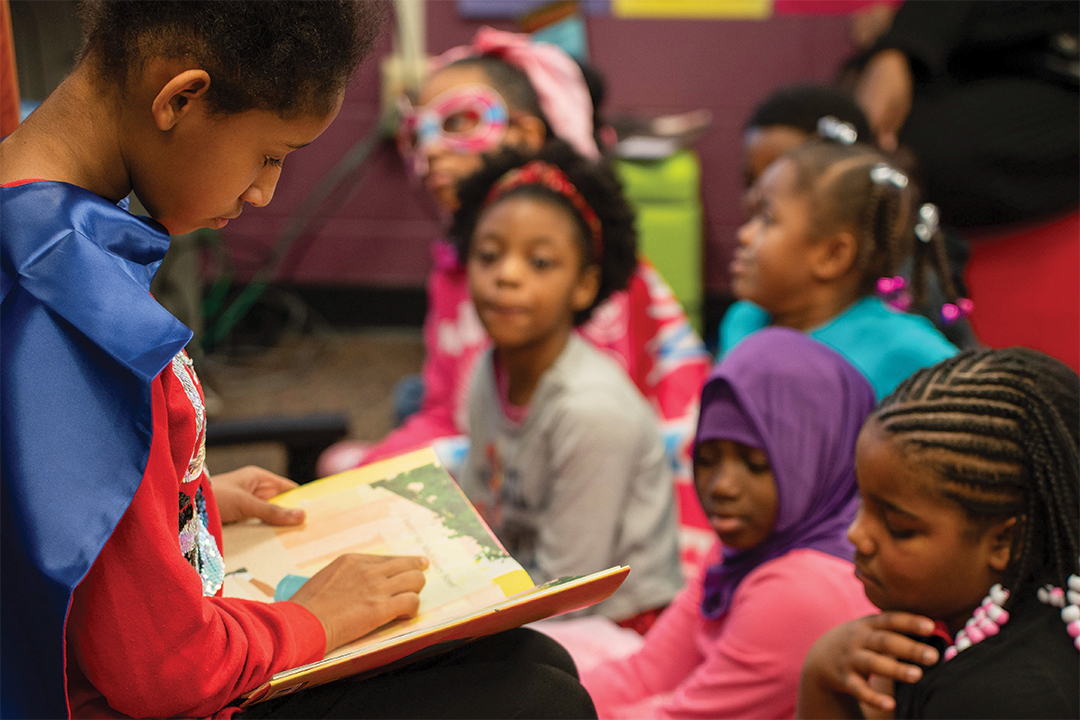
[Top photograph: Roll Hill School opened a new library with funding support from the United Way of Greater Cincinnati.]