

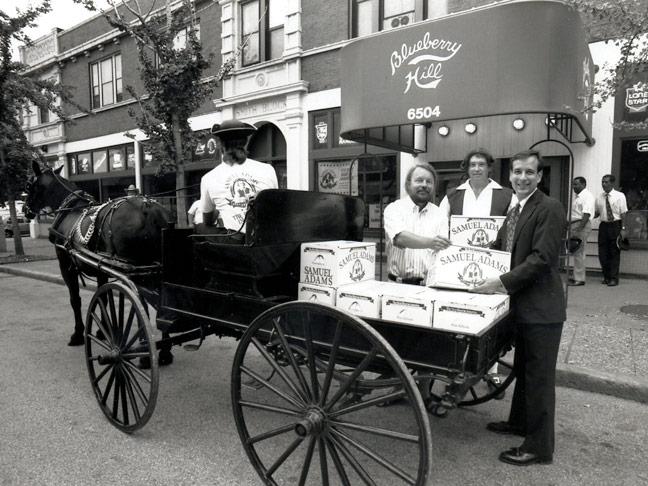
Samuel Adams Boston Lager made its debut 40 years ago at a few dozen bars and restaurants in Boston’s downtown and Back Bay areas. Its founder was a 35-year-old Cincinnati native who’d grown up in Mt. Lookout, graduated from Indian Hill High School, went to Harvard and got a law degree, and left a budding career as a management consultant to follow in his family’s footsteps in the beer-making industry.
Today, the company Jim Koch launched, Boston Beer Company, is a $2 billion publicly traded enterprise, and he’s considered a founding father of American craft beer, which has grown into a $29 billion industry. Boston Beer has deep roots in Cincinnati.
Brewing goes back four generations in the Koch family, and Jim’s paternal ancestors worked as brewers in the city’s 19th and 20th century brewing heyday. Company legend has it that his great-great grandfather’s recipe for Louis Koch Lager, discovered in the old man’s attic, was the foundation for Boston Lager, the beer that launched Sam Adams and Boston Beer as national names.
In 1997, as the company grew, Koch returned to his hometown and bought the former Hudepohl-Schoenling brewery, where his father worked in the 1940s. Boston Beer invested $100 million in that West End facility in 2020, quadrupling production with more canning lines and packing equipment to support the company’s growing lineup of brands. The company recently purchased additional property in the neighborhood that it will convert to a tractor-trailer staging area to be used for distribution. Boston Beer now employs about 350 people here.
While Sam Adams lager remains its signature product, Boston Beer has expanded its stable of brands beyond beer. Beverage innovations include Twisted Tea hard iced tea, Angry Orchard hard cider, Truly hard seltzer, Sun Cruiser iced tea and vodka, and Hard Mountain Dew. All are served at the Sam Adams Taproom near Findlay Market, across from the production facility.
In August, the company announced that Koch would re-assume the title of chief executive officer upon the departure of its previous CEO. He now adds that role to his list of titles: founder, brewer, and chairman of the board.
Koch’s family still owns a farm in Brown County, and Sam Adams has been the presenting sponsor of Oktoberfest Zinzinnati for many years. Koch comes to town each year to tap a ceremonial keg that kicks off the fourday riverfront festival.
Realm interviewed him about his Cincinnati connections, the history of the company, its growth and innovation, and the state of the craft beer business today. Here’s the conversation, edited for brevity and clarity.
[Photographs by Skylinn Jenkins]

YOU STARTED BOSTON BEER COMPANY AT AGE 35. HOW DID THAT IDEA COME TO YOU?
My father was a brewer, as were my grandfather and great grandfather and great-great grandfather. So beer was in my blood. I guess about .04 percent, so I was legal to operate machinery. But it wasn’t a very promising field to go into as a brewer, so I never really considered it, and I went off to college and graduate school, went to law school and business school, and was in Boston working for consulting company.
I was traveling all the time, and I had two kids. It was really hard on my family, and my wife wanted me to quit. She basically said, “If you don’t quit, I’m leaving.” She left anyway, but I did quit, though I didn’t want to work for a big company like my clients were—that wasn’t an environment I wanted to be inside. Big companies didn’t seem to be a place for the prosperity of the human spirit. They did lots of things well, but it was hard to put your heart into it and really get excited about work.
So I thought about what I could do with the rest of my life that would be cool and fulfilling, and the idea of starting a small brewery was very appealing to me partly because of my family background. I also had some familiarity with the brewing process because I’d been a home brewer. Craft beer really wasn’t much of a business sector back in 1984.
There were other businesses I considered, but I kept coming back to beer. At that point, there were maybe 10 microbreweries in the U.S. I think there was maybe one east of the Mississippi, in Albany, New York, and they’ve since gone out of business. So it was the very, very early days, and the unconventionality of it all appealed to me. But who wouldn’t want to make beer for a living, right? Even to this day, when people ask me what I do for work and I say I make beer, it always puts a smile on their face and on mine.
I got to work making it happen. I raised $140,000 from friends and family, and I had $100,000 in savings. So the investment was about what it would have taken to start a chili parlor.
YOU RECENTLY RE-ASSUMED THE ROLE OF CEO. HAS THIS MOVE CHANGED YOUR LIFE?
No, because I’ve been executive chairman and founder, so it’s not like I went away and came back. I wouldn’t have done it if it was going to change my life. There’s nothing I’m doing as CEO that I haven’t been doing for 40 years, but CEO is not the role I wanted to assume.
I’m not an especially good manager. I don’t like a lot of details and process. I’m not good at that. I have a short attention span. I’m not good at follow-up. You may not get your performance review if you report to me, and there are a bunch of things you do as CEO that come with the role that you have to do.
A LOT OF THOSE YOU CAN HAND OFF TO YOUR SENIOR MANAGEMENT TEAM, RIGHT?
Right. The CEO has to sit on the benefits committee, and I don’t want to sit on the benefits committee. I have to sign contracts if they’re over a certain amount of money. I don’t want to read contracts. I have a law degree, which makes me absolutely sure I don’t want to read contracts. I’m in the process of shedding as much of that clutter and focusing on the essence of the job, creating the culture of being the company leader, of driving the big rocks that are going to make us successful. At looking around corners and over horizons. That’s not just my role as a CEO, but as the founder.
HOW DO THE CINCINNATI OPERATIONS FIT INTO THE BOSTON BEER COMPANY’S BIG PICTURE?
The Cincinnati brewery is one of our two major breweries. We have our original brewery in Boston, which is in the middle of the city. So it was not a place that, as the company grew, could expand very much without becoming a really bad neighbor and bringing in 40 trucks a day through little city streets. It wasn’t practical to build that out. Our brewery in Cincinnati was the first one we acquired.
The Boston brewery is really our innovation and experimentation site for very small batches. Then, as we scale up, production goes to Cincinnati or our brewery in Pennsylvania.
WHY WAS CINCINNATI CHOSEN FOR A SIGNIFICANT EXPANSION OF THE OPERATION IN 2020?
Cincinnati has always had that German tradition of a high-quality workforce who come to work every day to do work they’re proud of. About five or six years ago, we were kind of at a watershed. Our business had grown a lot, and we needed more capacity.
The Cincinnati brewery, in this day and age, is not a place where you add capacity. You typically would find a greenfield site right off the interstate where there’s a nonurban workforce and you don’t have to deal with the city problems, like trying to get trucks in and out of congested areas. You would have plenty of space, big parking lots, all that stuff.
It was a $100 million investment decision, and my board questioned my sanity. Like, Why would you invest that in such a difficult environment? It’s in the middle of the city, it’s crowded, it’s not necessarily safe, and you got all these Teamsters.
HOW DID YOU MAKE THAT HAPPEN?
I had to explain to them that, yes, it might be a difficult environment, but the mayor at the time, John Cranley, said, “Look, I’ll help you, but we don’t have much money to give you.” I said, “That’s OK, what I may need is some help with permitting and those kinds of things. I won’t call you unless I really need it and it’s an easy ask.” Then the whole project was stopped because we couldn’t get a permit to open a parking lot we needed for construction workers because there was some zoning rule about the height of the fence. I called the city and said, “We need a zoning variance. Can you see if you can get the zoning board to meet on this on Wednesday and not in six weeks?”
As a business person, you don’t necessarily have your hand out for money. What may be more valuable is just somebody who can make good business decisions on the behalf of the city and not spend two months trying to do it.
YOU ALSO WORKED WITH THE EMPLOYEES?
We talked to the union leadership. They knew that if we didn’t invest in the facility their jobs were going to go away. They worked with us on making sure it would be a good decision and gave us a seven-year contract. It’s a pain in the ass for everybody negotiating union contracts, not because of the content but because in preparation for it you’ve got to fill warehouses with product for your wholesalers in case there’s a strike. It’s very disruptive, and then when you settle you’ve got all this product and everybody’s ready to come back to work.
So we were able to work cooperatively and constructively with the workforce. I convinced the board that we had a great workforce there and, sure, we could go out three counties over, but we weren’t going to duplicate those workers. Cincinnati, to me, had these intangibles I valued. So I had to tell the board, “Trust me.”
BOSTON BEER HAS BEEN AN INNOVATIVE COMPANY. CAN YOU TALK A LITTLE ABOUT HOW YOU BUILT THAT CULTURE?
Innovation is not a separate activity, it’s part of how we look at the world. It’s part of our fundamental motivations and is embedded in our culture. One of our values is “The status quo sucks,” and our mentality is the status quo only exists because we haven’t had yet an opportunity to improve it or just haven’t found or taken advantage of the right opportunity. Innovation is not just new products—it’s, for example, new ways of doing business. Before I started Boston Beer Company, I was a manufacturing consultant, which I did for seven years. It was an exciting time then, because the Toyota production system, the lean manufacturing system, was just revealing itself, offering new principles about how you make things.
HOW DO THOSE CONCEPTS WORK IN BEER-MAKING?
Equipment makers have not been very forward looking, for one. There are opportunities to rethink how we make beer that comes from our craft roots. One of them is, in the old mentality, long runs were considered efficient. But in lean manufacturing, short runs are the key to efficiencies because they get rid of inventory. If there are defects, you find them really quickly.
Some of these concepts flip the script. In old manufacturing, the more you treat your people like robots, the more productive they are. But the opposite is actually true: The more you can engage them in the process, the more productive and efficient they’ll be.
WHERE DO YOU SEE THE CRAFT BEER INDUSTRY TODAY?
American beer was a joke in most people’s minds 30 years ago. If you wanted good beer, you were drinking imports. People would say American beer could float on water because it’s so thin and light, like the foam is on the bottom. Today, the best beer in the world is made by American craft brewers. The quality of our beer is respected everywhere, and we’re the innovators in the beer world. The rest of the world looks to American craft brewers for innovation.
Today, the United States is the best place in the world to be a beer drinker. You get higher quality and more variety. Virtually every style of beer is made at its highest quality in the United States. It might have originated in Belgium or Germany, but it finds its flowering and its best representation here. I imagined such a thing, but only in my wildest dreams. And it came true. There was almost 40 years of growth, and now there are 10,000 craft brewers.
HAS THE CRAFT BEER MARKET HIT A PLATEAU?
There is a little bit of angst that we’re not really growing anymore. My response to my fellow craft brewers when I give talks is, Yes, that’s true, we are a mature industry. Guess what? That’s what success looks like. We are an enduring, permanent part of the American beer landscape. Do you have any idea how hard it was to make that happen, guys? That’s what success looks like.
What that means is we can’t just show up and assume people are going to drink our beer. They have lots of choices. Now we have to compete. We have to push ourselves to be better. We have to be sound business people and be centered around serving our customers and innovating to create cool, new things. But that’s every business in the world, right?