


Every commercial airplane that lands at CVG requires maintenance by licensed technicians to fly safely. That’s hundreds of flights in and out every week, and yet a nationwide shortage of aviation maintenance technicians threatens to curtail flight expansion here and elsewhere. Cincinnati State is attempting to fill the talent gap by expanding its popular aviation maintenance technology degree offerings.
Program Chair Jeff Wright, himself a Cincinnati State alum, says proof of student interest is in the enrollment numbers. “Since I’ve been the program chair, we’ve grown from approximately 80 students up to about 195, more than doubling our growth in the last eight or nine years,” he says. That mirrors overall industry growth across what he refers to as the region’s aerospace corridor, fueled by manufacturing, commercial, and passenger airline expansions.
Cincinnati State’s degree model turns students into earners before they graduate, taking advantage of businesses that offer co-op opportunities. When he was a student, Wright participated in a co-op with Comair Airlines that launched his aviation career. “A lot of students have the opportunity upon graduation to continue on with their employer,” he says. “Some of the employers train them while they’re here so they’re hiring trained employees right out of college.”
It’s one of a handful of programs at U.S. colleges offering paid co-ops, which are real-world placements at which students make $20 to $25 an hour while working alongside technicians at companies like GE Aerospace and Delta Air Lines. The work is woven into an FAA-certified curriculum where students split time between classroom instruction and hands-on training in hangars filled with aircraft engines, avionics systems, and helicopters.
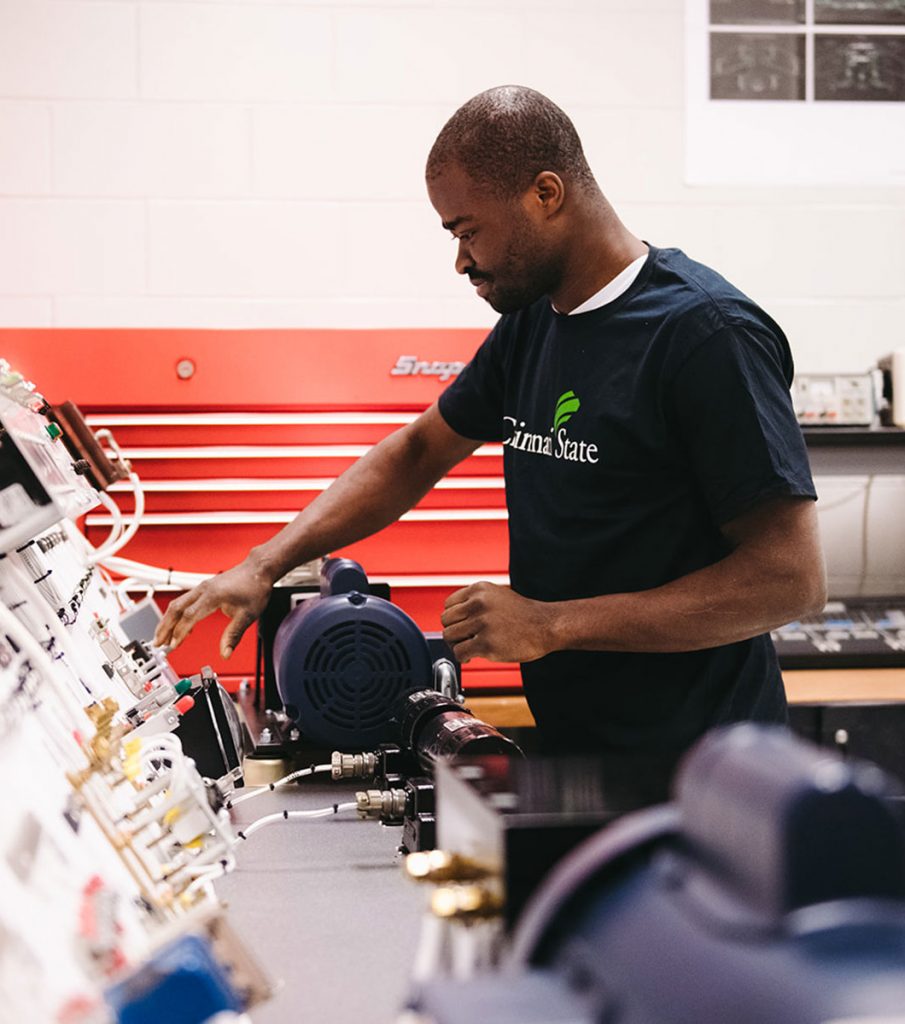
Cincinnati State’s two-year program allows students to earn certifications that qualify them for jobs paying $30 to $48 an hour immediately upon graduation, creating what Wright calls turnkey-ready employees who require minimal additional training. The model works so well that employers don’t wait for career fairs but come directly to campus, with PrimeFlight recently hiring 30 to 40 students and GE Aerospace hiring 10 co-op positions. Students who want a job graduate with a job, Wright says, with placement rates near 100 percent.
Because of the program’s success, Cincinnati State has proposed an $8.6-million expansion to grow its 33,000-square-foot Harrison campus facility to 54,000 square feet by adding a second hangar, new labs, and more classrooms. Capacity would nearly double, allowing enrollment to grow to 350 students.
As CVG continues to grow commercial operations with Amazon and DHL as well as with passenger airlines and GE Aerospace serving as a worldwide leader in engine technology, the demand grows for aviation maintenance technicians. CVG officials project a need for 1,300 additional AMTs in the region within the next few years, while Boeing forecasts a need for 716,000 new AMTs globally over the next two decades.
“The need is literally worldwide,” says Wright. “Companies come to us, and we’re trying to fill the need for these local and national employers.”