

Sharmili Reddy started work as Covington City Manager in mid-August, bringing 20 years of experience in Northern Kentucky government to one of the region’s highest profile positions. She’s had little time to catch her breath, jumping right in to manage once-in-a-generation projects, including a brand new City Hall, redevelopment of the old IRS site, and a major bridge closure.
Covington has always played a prominent role in the region as the largest city in Northern Kentucky and fifth largest in the state. But the current activity level there would be impressive for much larger municipalities.
In the next few months, the state will tear down the Fourth Street/Route 8 Bridge for a total replacement, cutting off a major east-west route across Northern Kentucky, and the first housing construction will start at the Covington Central Riverfront site, former home of the IRS processing complex. Over the coming year, construction of the new City Hall on Scott Street will wrap up, design plans will be released for the University of Kentucky’s new medical school and Northern Kentucky University’s new law school buildings downtown, and Brent Spence Bridge site work will finally get underway.
Oh, and the position of Covington City Manager goes away at the end of the year. City voters approved a shift from the City Manager form of government to the Mayor/Council system several years ago, and it takes effect on January 1, 2027. Reddy will help Mayor Ron Washington and City Commissioners set up the new structure while hoping to continue serving in leadership.
Reddy has navigated plenty of change in her career, working in several planning and administration capacities in Ft. Mitchell and Kenton County. She first came to the region from her native India for a master’s degree in community planning at UC’s College of Design, Architecture, Art, and Planning, then worked in Pennsylvania and Louisville before moving back here in 2005.
She spoke with Realm to discuss the city’s beehive of activity and her plans for proactively engaging residents, businesses, and visitors during this busy period.
[Photograph by Andrew Doench]
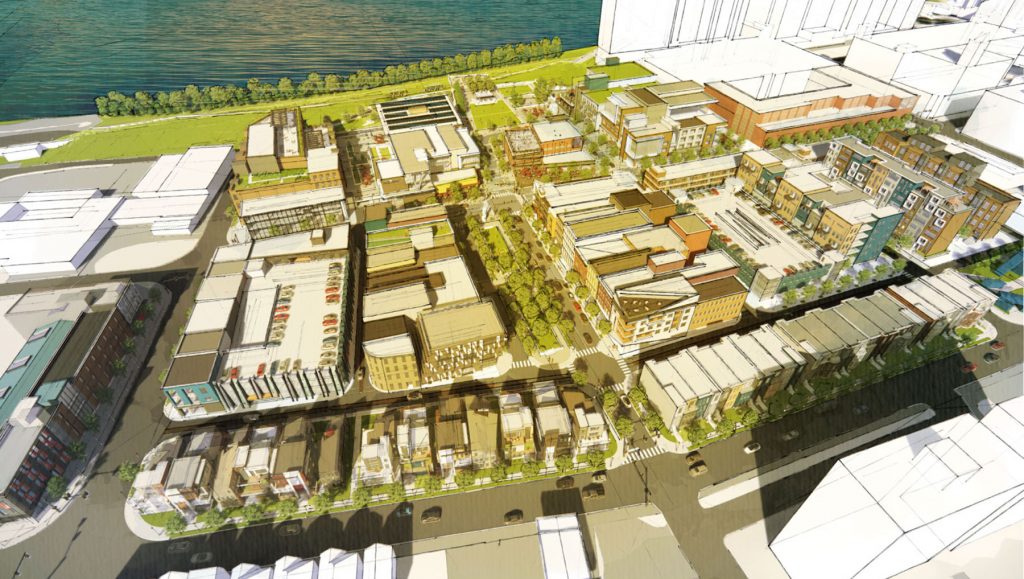
Your highest profile development effort right now is the Covington Central Riverfront project at the old IRS site. You’re essentially creating a new urban neighbohood and enlisting different developers to build their own blocks so the area doesn’t end up with a uniform look and feel, correct?
Our first phase is about installing—or reinstalling—public infrastructure to the site, starting with the basic street grid network. Three lots have been sold, and we know the development happening there. Block A just broke ground in December and will consist of 10 single family homes along Fourth Street from Funke Real Estate Group. Next to that in Block B will be 16 townhomes from Drees Homes. We’ve also sold Lot M, which will be 257 apartments in two five-story buildings, along with about 7,000 square feet of commercial space. So we know those three are going to happen in a fairly short timeline.
Phase 2 will include a parking garage that needs to be built in order to spur development across the rest of the site. So between the garage and the street grid, we will have put the basic public infrastructure in place. As other developers start to see the first housing and the garage come out of the ground, they’ll be able to visualize what the site could actually look like and that it’s happening. A bold vision like this takes time and patience, and we’re more focused on getting it right than getting it done fast.
This project reminds me of what’s happened in Over-the-Rhine, where they needed someone to take a chance and go first with investment.
It’s been about five or six years since the city’s original vision was set, but we’ve never said that there wouldn’t be changes along the way. Residents and businesses continue to provide feedback. Like with any other vision, we review our assumptions and our plans over time and make sure that it’s all progressing well.
Another high-profile development is the OneNKY Center at the Roebling Bridge, which opened in September as a gateway to the city across from The Ascent. How does bringing Northern Kentucky’s economic development organizations under one roof there benefit Covington?
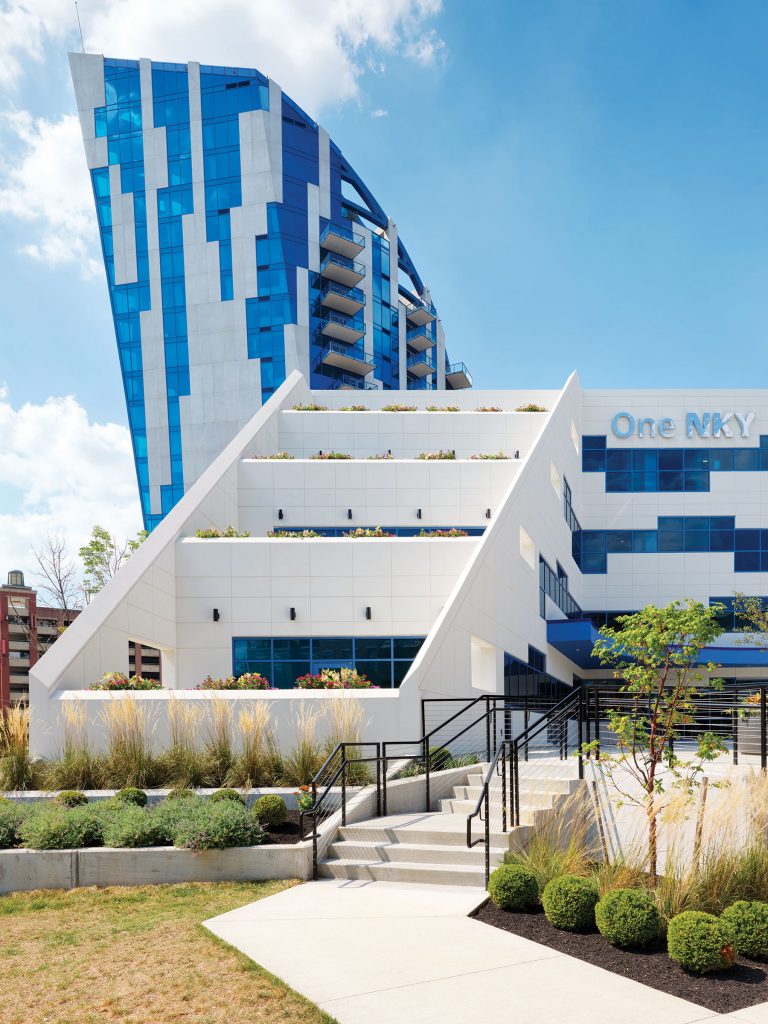
We are thrilled to have them all choosing to be in downtown, which will certainly help Covington coordinate better on regional and statewide issues. We have so many things happening right now that it’s really nice to have meetNKY, BE-NKY, the Northern Kentucky Chamber, and others close by. At the end of the day, it’s an amazing office space bringing employees to our restaurants and our riverfront amenities and bringing clients and visitors to our city.
We’ve already been in meetings with the various organizations when, once we’re in the building, we’ ll just walk over to the folks at another one to ask what they think of this or that. And the state invested $15 million to build the LifeSciKY space on the building’s second floor, which will offer lab and startup support to life science research organizations that otherwise would have to invest in building out their own spaces. I like to think about it as entrepreneurship in the life science arena, and there’s nowhere else in Kentucky where that’s available.
Covington has invested in local entrepreneurs and, in particular, in small businesses. Why is that a priority?
SparkHaus is our most recent development when it comes to those focus areas. It officially opened in September on Madison Avenue to provide co-working space, private offices, and meeting/event space for entrepreneurs. The city’s Board of Commissioners established a grant program for SparkHaus that will be used to attract companies from outside Covington to locate there and cover administrative costs for Entrepreneur Day Programming for local high school students, among other initiatives.
One great example of what’s happening at SparkHaus is the startup Proximity, which moved into the building once it opened. The founder, Grant Murray, is working on innovative solutions for parking, and I don’t know all the details, but he’s working with Covington’s parking authority— and other cities—to figure out parking solutions in urban settings. If you’re in an urban environment, you know that parking is always a big issue. Now that he’s working at SparkHaus, we hope he falls in love with Covington and the business is successful and he decides to stay here when he expands and looks for office space.
Supporting small businesses is a huge priority for us. They’re an integral part of our entire commercial ecosystem here and why people love coming to Covington. We’ll also be recruiting small, locally owned businesses to the Central Riverfront mixed use lots. Our streets are packed on weekends.
People love the vibe we provide. So we do a rent subsidy program, a facade improvement program, and a historic sign restoration program, and Covington has invested a total of $1,016,827 across all three programs. Small businesses, in turn, invested $11,406,187 of their own capital, an impressive ratio of 1:11.2. I love the charm and the vibe that old signs bring to our business districts.
As neighborhoods become successful—from MainStrasse to the Madison and Pike section to the new central riverfront development—how do you keep residents and small businesses in place?
One of the key initiatives Mayor Ron Washington has focused on since he took office is housing. We’re very clear that Covington is an inclusive community. We want everybody here, and we’re very welcoming. The market will do what it does, but we can still look for specific strategic opportunities where we can accommodate everybody. We’re in the preliminary phases of planning that housing initiative, but it targets that $15- to $25-an-hour person: teachers, firefighters, people in the service industry. Some people call it workforce housing or affordable housing or attainable housing, but it’s about helping people who are not making a lot of money stay where they want to live and not get priced out. Housing affordability is an issue across the country.
Mayor Washington recently took some of us on a tour across the city to remind everyone that Covington is more than just north of Fourth Street. The city goes all the way to Taylor Mill, and so much of our community is truly affordable. Latonia is a beautiful, tight-knit community that offers good amenities, is easily accessible, and has smaller starter homes. Prices are still higher than 10 years ago, but there is still so much to the city that allows people to stay in their homes and preserve that residential character we’ve had for a long time.
Speaking of north of Fourth Street and accessibility, what is the status of the Brent Spence Bridge project in Covington?
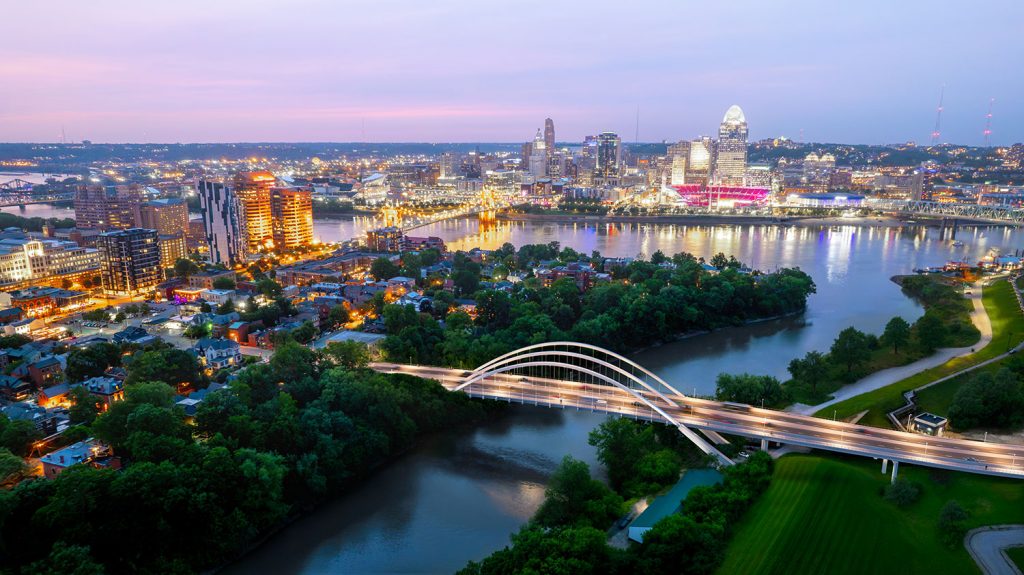
I know it often seems like nothing is going on with this project, but we are deep in that world every day at City Hall. There are two bridge projects taking up a lot of our time behind the scenes: Brent Spence and the Fourth Street/Route 8 Bridge connecting to Newport, which closes in mid-January. The public portion of the Brent Spence project is supposed to start in some capacity in late spring.
In my four months here I’ve seen excellent cooperation among government and business interests to get ready for both, particularly the Fourth Street project. That bridge is being torn down and replaced on the same site, with a two and a half year timeline. Brent Spence is going to take longer, of course, potentially five to six years.
The Kentucky Transportation Cabinet has been very supportive of the city’s efforts. In December Mayor Washington announced a $750,000 state grant to help fund our Bridging the Gap program to keep residents, businesses, and visitors informed and engaged throughout both bridge projects. Obviously, communication will be one of the biggest items with that.
Can I ask you if you’ve learned some lessons from the I-471 bridge fire in late 2024 that really impacted Newport and Bellevue businesses and commuters?
We absolutely learned lessons on the impact and what those communities did to minimize that impact by coming up with creative solutions and incentives. They had to react to the fire, while we’re able to be more proactive and make plans now to partner with our businesses. They know their clientele and what brings people to down town Covington, so we want to be supportive of their ideas on how to keep bringing customers through their doors.
We’re talking about proactive communication and marketing and telling our visitors and workers, Hey, it’s still easy to come to Covington. These projects might be happening, but the city is still open for business.
We’re working closely with Newport, Campbell County, Kenton County, meetNKY, the Chamber, the Kentucky Transportation Cabinet, and other partners. So the theme of regionalism is super important for this project, because the Brent Spence Bridge is not only huge for the future of Kentucky, it’s huge for the country because of the amount of GDP that moves across it.
We put together a group of folks representing businesses in three different districts in Covington—MainStrasse, the central business district, and Roebling Point—to ask for ideas. And what’s come out of that is some really cool concepts people are excited about. We talked about how we can let people know that it’ll still be easy to get around Covington and park during these bridge projects.
We’re hoping that a lot of these short-term projects will benefit the city long after the bridges are finished.
Will Covington be able to take advantage of the new Brent Spence Bridge configuration to recapture usable land as planners are hoping to do on the Cincinnati side?
This project is not so much about new land on the Covington side, and this is where our partnership with the Kentucky Transportation Cabinet has been fantastic. We are getting a new master plan for Goebel Park next to the highway, which has been needing some attention for a long time.
We’re working on a maintenance of traffic plan with KYTC in order to minimize traffic disruptions during construction. We will know three months ahead of time before any closures take place, and there will be at least one highway exit for Covington maintained at all times.
The University of Kentucky is opening a medical school in downtown Covington, while Northern Kentucky University is relocating its law school there. What will those projects mean for the city?
The more people we can bring here to get the Covington experience, the more exciting it is for us as a city. These schools will bring a whole new population and age group to the city that’s going to truly raise the bar here. Of course that’s going to spur some additional development—new housing, maybe—and new partnerships. I wonder, for instance, would the new law school attract more law firms to locate nearby, or doctor offices or medical groups to locate near the med school. I mean, the state’s future doctors and lawyers are going to be educated right here, and I hope some of them would just naturally stay because they’d fall in love with the place.
You’ve worked in local government in multiple Northern Kentucky jurisdictions and often been on the other side in conversations or negotiations with the city of Covington. Have you started to take advantage of your connections around the region to benefit Covington?
I’ve been in the region for about 20 years now, and my roles have kind of morphed over the years between countywide, then city, then back to countywide, and now back to city. You can say this about Cincinnati in general, but Northern Kentucky is a really tight-knit community. Everyone is either related to somebody or knows somebody. It’s literally like one degree of separation. It took me a while to become a part of that fabric, but I’ve received tremendous support and encouragement in every role I’ve held.
Thinking regionally but acting locally is in my DNA. So anytime we need resources or a connection or some help, I feel like I know who to call. I know who to rely on, because the relationship is already there.
I wouldn’t say that getting things done in Covington is difficult, it’s just more complex because the issues we deal with aren’t necessarily issues you deal with outside of an urban core. But it certainly helps to have that perspective from the outside looking in and now being in it.
The Southbank Partners organization pulls together city managers and administrators from Northern Kentucky’s river cities to meet monthly. So we’re in a room every month talking about new projects, challenges, and how to coordinate. We tend to lean on each other. I feel like at any point in time I can pick up the phone and call one of them and be like, Hey, are you dealing with this? What have you done with that? So we’re not reinventing the wheel and can move faster. We deal with similar issues as Newport, Bellevue, Dayton, and Ludlow, and we also have similar goals: trying to increase housing and small businesses, trying to attract and retain talent, trying to bring in visitors.
Covington city voters voted to change from a City Manager form of government to more of a strong mayor structure in January 2027, which means your job goes away in a year. If so, why did you take this job?
Many big and medium-sized cities have a City Administrator structure for a reason, because we’re supposed to be nonpolitical, focused on the community needs, and helping elected officials implement their priorities. So my role will change from a title standpoint, from City Manager to City Administrator, and the mayor will be the city’s executive authority.
My focus is on doing a good job for the city in the next year. I’m not too worried, to be honest—I want to give it all I got, and I’m hoping to roll into the City Administrator role.
I’m used to the mayor/council form of government from previous jobs, so I’m already kind of shifting to that mindset, knowing that it’s coming in a year. The next year will see us updating our city ordinances to reflect this new form of government and improving efficiencies. For instance, under the current system every single city employee hiring has to go through the Board of Commissioners, which means at least a two-week public process. In the new form of government, other than the four positions that are statutorily required to have council approval—City Administrator, Police Chief, Fire Chief, and City Clerk—the others can be handled administratively under the Mayor’s authority. That’s a new level of efficiency in a 400-person city staff, though we have to balance that with not losing accountability and public scrutiny.
We have a transition committee in place made up of residents who are helping the city look at new efficiencies, and we’re hoping to have a plan in place by July.