


The most expensive acquisition in Fifth Third’s history will undoubtedly transform the future of Cincinnati’s biggest bank. But one impact is already apparent: busier workers in Post Offices across Texas. Fifth Third is dropping millions of direct mail flyers to homes and businesses in the communities served by Comerica, the big Dallas-based bank it just acquired. The brand is a relative unknown there, but that’s expected to change quickly.
In February, Fifth Third closed on the Comerica acquisition, an all-stock deal valued at $10.9 billion. It was the biggest bank acquisition announced in the U.S. in 2025. The deal brings a big regional bank with $80 billion in assets and 350 branches in Texas, California, Arizona, Florida, and Michigan under the Fifth Third banner. With the deal sealed, the bank’s marketing team went to work to keep existing Comerica customers in the fold and recruit new ones.
“We’re going to drop a million pieces of mail within the first two weeks,” Fifth Third Chairman, CEO, and President Tim Spence said in January when he announced the bank’s 2025 financial results. “It’ll be the first million of what will probably be 13 or 14 million pieces of mail that will go out over the course of the year.”
The combination of the two brands immediately created one of the top 10 largest banks in the country, with $294 billion in total assets. That will grow, as the mail bombardment is one page of the Fifth Third playbook to accelerate deposit growth and deepen customer relationships across Comerica’s markets.

Fifth Third says the acquisition means it will operate in 17 of the 20 fastest-growing U.S. markets. Comerica had gained a reputation for serving midsized businesses and a practice offering financial services to corporate customers, entrepreneurs, and professionals in the technology and life sciences sectors.
Fifth Third has identified more than $500 million in revenue opportunities from the acquisition over the next five years, Chief Operating Officer Jamie Leonard told analysts at a banking conference in February. Much of that will come through bringing revenue from Comerica’s existing branch network up to Fifth Third standards for financial performance.
While Comerica branches in its founding state of Michigan are performing up to par, its branches in the Southwest are generally underperforming at roughly $30 million in deposits per branch, according to Leonard. Fifth Third will apply the principles of its growth playbook to those banking centers. “We need to bring the Fifth Third process, technology, products, and marketing to the Comerica branches,” he said. “We’ve got to get them from being a $30 million per branch franchise to being a $70 million or $80 million per branch franchise. That’s one of the big deposit opportunities ahead of us.”
That’s where that direct mail blitz comes in. “Comerica will see its first major consumer deposit campaign in more than a decade,” Leonard said. “Direct mail remains one of the highest performing tools in our customer acquisition toolkit.”
The combined company also plans to seek $850 million in “expense synergies,” or cost reductions, over the next few years, with many of the cuts coming in technology roles, as the bank consolidates its systems and eliminates duplicative functions. It’s unlikely that job reductions will occur in Cincinnati, where Fifth Third employs about 6,750 people, says Dan Feldmann, president of the Cincinnati market. Over time the acquisition could add jobs here, particularly in the Madisonville operations center, which supports Fifth Third operations around the country.
He says a bigger bank will benefit the headquarters city simply by having more capital to invest in area mortgages, commercial loans, and other financing tools. With the bank’s overall assets growing by more than a third, “We’re going to have more capital at the corporate level to continue to invest in our communities, including right here in Cincinnati,” says Feldmann. “Scale definitely matters.”
Beyond the dollars and cents, Fifth Third’s ascension to a top 10 U.S. bank will have a significant impact on its hometown, says Cincinnati Mayor Aftab Pureval. “The acquisition elevates the city’s profile as a business center that’s focused on growth,” he says. “I’m energized by Tim Spence’s bullish approach to his company’s future and, more specifically, to its future in downtown.”
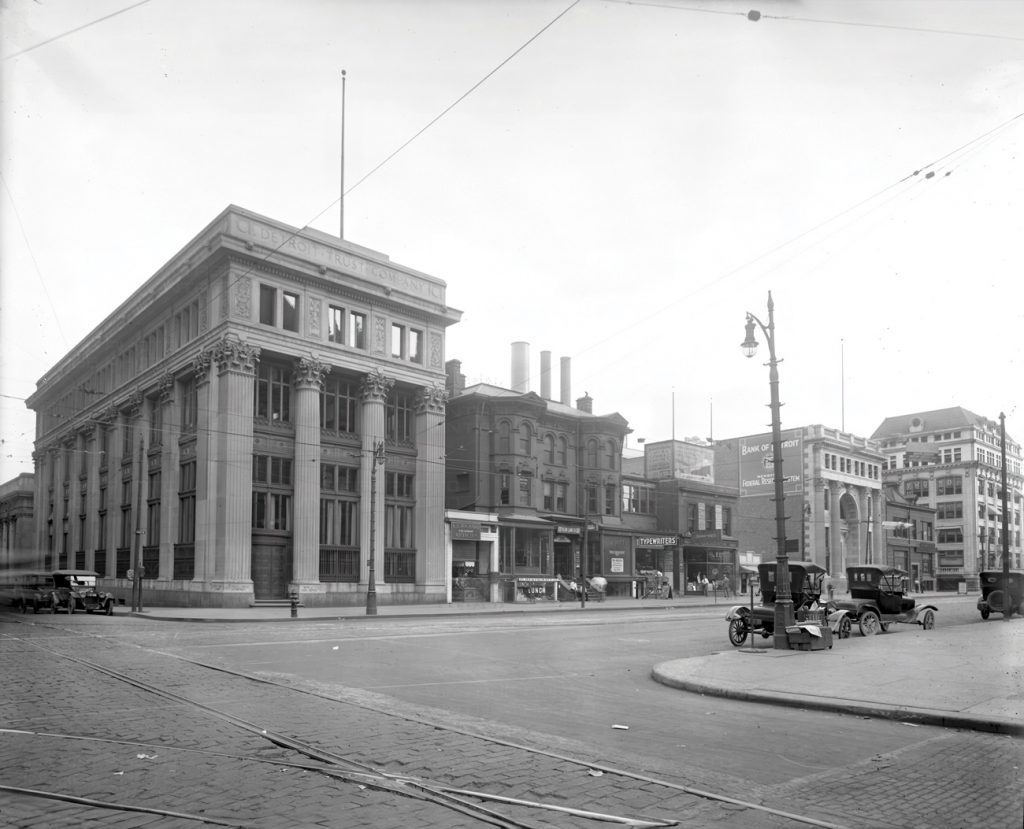
Comerica was founded in the 19th century as the Detroit Savings Fund Institute and, through mergers with other Michigan-based banks, evolved into the Detroit Bank & Trust Co. in the 1950s. The company created a bank holding structure in the 1970s, enabling its growth beyond Michigan, and began an aggressive expansion
in the early 1980s into Florida, California, and Texas. The name Comerica was adopted in 1982 to represent its presence beyond its home state of Michigan. It purchased the naming rights to the Detroit Tigers baseball stadium in 2000, Comerica Park. (“It’s too early to discuss any potential changes to facility names,” Fifth Third says.)
Comerica grew quickly in the early 2000s through acquisitions and organic growth, and in 2007 it relocated its corporate headquarters from Detroit to Dallas, chasing population growth in the Sunbelt. In addition to seeking growth in Comerica’s existing financial centers, Fifth Third is planning a major expansion of its branch network in the Southwest, particularly in Texas, which leaders see as one of the nation’s most attractive banking markets. The bank plans to open 150 new branches across Texas through 2029, with an emphasis on the Dallas, Houston, and Austin markets. More than a quarter of those sites have already been secured, Leonard said.
That’s partly due to continuing to work with developers in the Southeast building grocery-store anchored strip centers that could accommodate new bank branches. “Because of the success we’ve had with them in the Southeast, they came to us after the (acquisition) announcement and gave us a lot of early opportunities,” Spence said. “The brick and mortar will actually come out of the ground faster in Texas than it did when we started the Southeast expansion.”
The Fifth Third brand is now a significant presence in Florida, the Carolinas, Georgia, and Tennessee, thanks to a combination of relatively small acquisitions and then sustained expansion. Since launching its Southeast expansion campaign in 2018, Fifth Third has opened 182 new branches, upgraded 22, entered 16 new markets, and added more than 700 employees in the region. The expansion is expected to grow deposits by $15 billion to $20 billion over the next seven years.
That’s the pattern it now plans to employ in the Lone Star State. “We’re bringing that formula to Texas at scale with these 150 new branches,” said Leonard. “We are positioned to achieve top-four brand share in Dallas, Houston, and Austin by the end of the decade.”
By then, the bank that traces its origin to the 1908 merger of Fifth National Bank and Third National Bank in Cincinnati will have more than half of its retail network located across the Southeast and in Texas, Arizona, and California. An expanded branch network provides entry points for Fifth Third to offer depositors other products such as auto loans, wealth management services, and business lending. “Getting somebody in the door is just the beginning,” Leonard said. “We don’t bring them in to open an account and leave it alone. Our sales process is highly interactive with the customer.”

The bank plans to offer its small-business lending services across the Comerica network. And Comerica’s experience lending to midsized businesses, generally those with revenue between $10 million and $500 million, was attractive to Fifth Third. “They were a powerhouse in what we consider middle-market banking,” says Feldmann. “Pre-Comerica, we had about 350 commercial bankers at the end of 2025. With Comerica, we now have more than 600.”
The bank is reviewing Comerica’s commercial clients one by one to identify where its heftier balance sheet could offer opportunities to provide expanded services to existing business customers. Comerica also employed a specialized banking group with experience supporting startups and venture-backed companies in tech and bioscience. Fifth Third plans to integrate its Newline electronic payments platform with the tech and life sciences group “to build a scaled, innovation economy franchise,” Leonard said. Beyond the basic blocking and tackling of branch expansion, executives say, that’s where the long-term growth opportunities lie.
“The blue-sky opportunity here is innovation banking,” Spence told analysts. “That will continue whether it’s technology, AI, software, the things that are coming out of Silicon Valley, or life sciences and the transformation that’s going to go on in health care over the course of the next decade. Those sectors really are the drivers of the American economy.”
The Comerica acquisition was the first for Fifth Third since its 2019 purchase of Chicago-based MB Financial, a $4.7 billion deal. Leonard said the MB acquisition and integration succeeded largely because some of the MB leaders were retained, including CEO Mitchell Feiger, who was named chairman and CEO of Fifth Third’s Chicago region and then joined Fifth Third’s board upon his retirement.
With the Comerica acquisition, the bank’s chairman, president and CEO, Curtis Farmer, takes on the role of vice chair at Fifth Third, while Peter Sefzik, Comerica’s chief banking officer, will lead Fifth Third’s wealth and asset management business. Three members of Comerica’s board have joined the Fifth Third board. Farmer will join when he retires, the company announced.
Other long-term senior Comerica leaders are staying on in significant roles as regional presidents in Michigan, Southern California, and North Texas. “When you keep the right leaders from the franchise you’ve acquired, you ultimately do a better job with relationship manager retention and therefore customer retention,” Leonard said.
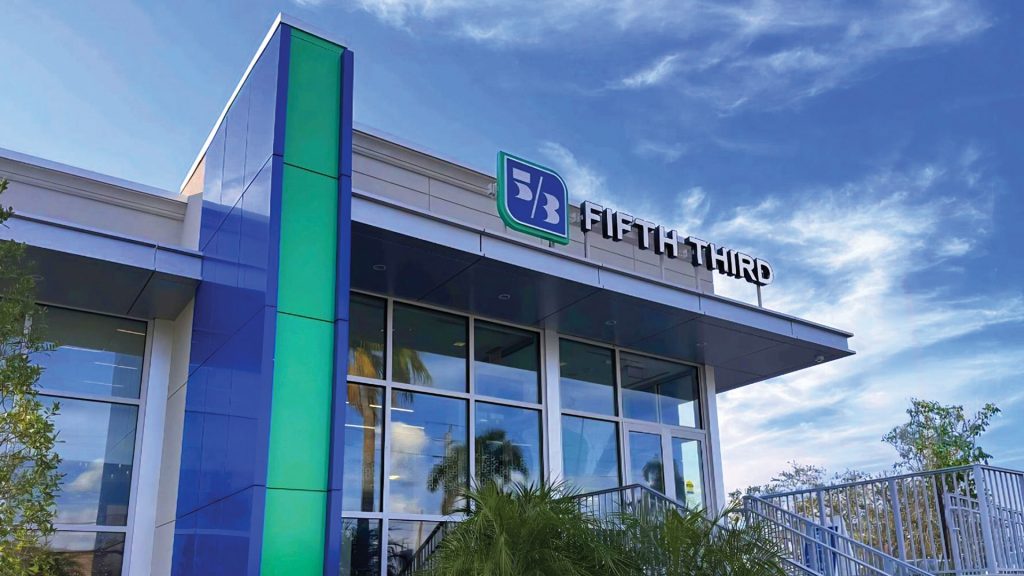
The acquisition of Comerica, Fifth Third’s largest purchase ever, immediately grew its total assets by more than a third. The bank’s merger and acquisitions team prepared the enterprise for an acquisition of this magnitude following its unsuccessful effort to take over San Francisco-based First Republic Bank in 2023. That bank was seized by regulators and sold to JPMorgan Chase following a massive run on its deposits.
Fifth Third was one of four banks that submitted bids for First Republic in a weekend auction conducted by the Federal Deposit Insurance Corp. Although the Cincinnati-based bank lost out, the experience sparked an internal exercise to ready the institution for an acquisition of a similar size. (The First Republic sale was valued at $10.6 billion.)
“When First Republic didn’t work out for Fifth Third, we decided we were going to make sure that in the event another opportunity materialized we’d be ready,” Spence told analysts in January, explaining that the team stress-tested the bank’s systems and manual processes to see how it would handle integrating a major acquisition. “The real question being: Would anything break if the bank doubled in size?”
As Bank of America analyst Ebrahim Poonawala said, “Whenever we have banks go through a merger or a large transaction, I think the question is, Will management be spread too thin? Does it take the focus away from organic growth?”
The Comerica acquisition doesn’t double Fifth Third’s size, but Spence said the work done after the First Republic bid prepared leadership to move quickly to absorb Comerica. “The things that we needed to make sure that we got done in order to support that were already done,” he said.
That work, as well as getting the necessary regulatory approvals by mid-January, contributed to the transaction closing earlier than expected, on February 1. That, in turn, has led the bank to move up the timeframe for fully converting Comerica’s network, signage, and branding from mid-October to early September.
Fifth Third executives are practiced at integrating newly acquired banks. Much of the bank’s growth over the last three decades has come from acquiring established local banks, integrating their operations, applying Fifth Third’s performance standards and incentives, extending consumer and business relationships in those communities, and then expanding in those markets.
In the 1990s and early 2000s, under the 16-year tenure of CEO George Schaefer, Fifth Third rolled up banks to extend its reach well beyond Cincinnati. Many were relatively small acquisitions that provided the bank platforms for growth in new markets. It was a steady march north to Dayton, Columbus, and northeastern Ohio; south to Kentucky; and west to Indiana.
The company entered Michigan in a big way in 2000 with the purchase of Old Kent Financial, at the time its largest acquisition, valued then at $4.9 billion. It entered Florida in 1989, following snowbird Cincinnatians there, and amplified its presence in 2004 with the purchase of First National Bankshares of Naples, a deal valued at the time at $1.6 billion.
Under Schaefer, Fifth Third made more than two dozen acquisitions, growing from a regional bank into a “super-regional” operating in 10 states. But the rapid-fire acquisitions created its own issues, and federal regulators placed a temporary moratorium on acquisitions for several months in 2002 and 2003 to allow Fifth Third time to upgrade its internal controls.
Kevin Kabat succeeded Schaefer as CEO in 2007 on the eve of the biggest financial crisis since the Great Depression. Fifth Third, like most financial institutions, saw the price of its shares fall dramatically. Kabat improved the bank’s efficiency and upgraded its technology and left the bank in a much stronger position when he stepped down in 2015. He was succeeded by Greg Carmichael, who committed to the growth strategy in the Southeast markets.
In 2022, the board gave the CEO title to Spence, who joined Fifth Third in 2015 as chief strategy officer and led the bank’s consumer bank, payments, and strategy work before being named president in 2020. Prior to Fifth Third, Spence was a senior partner in the financial services practice at Oliver Wyman, a global strategy and consulting firm.
A successful integration of Comerica is tops on his to-do list at the moment. When a financial analyst asked if he would consider another acquisition, Spence replied, “The focus really is on making sure that we get the Comerica customers converted and taken care of and that we make the company, from an employee perspective, feel like one company and that we get the expanded capabilities that both Fifth Third legacy customers and Comerica customers are going to benefit from.”
Although the bank’s growth focus now shifts to the Southwest, it continues to grow in Cincinnati, where it already holds a large share of the consumer financial market. The largest commercial lender in this region, Fifth Third has gained five percentage points in market share since 2019, says Feldmann.