

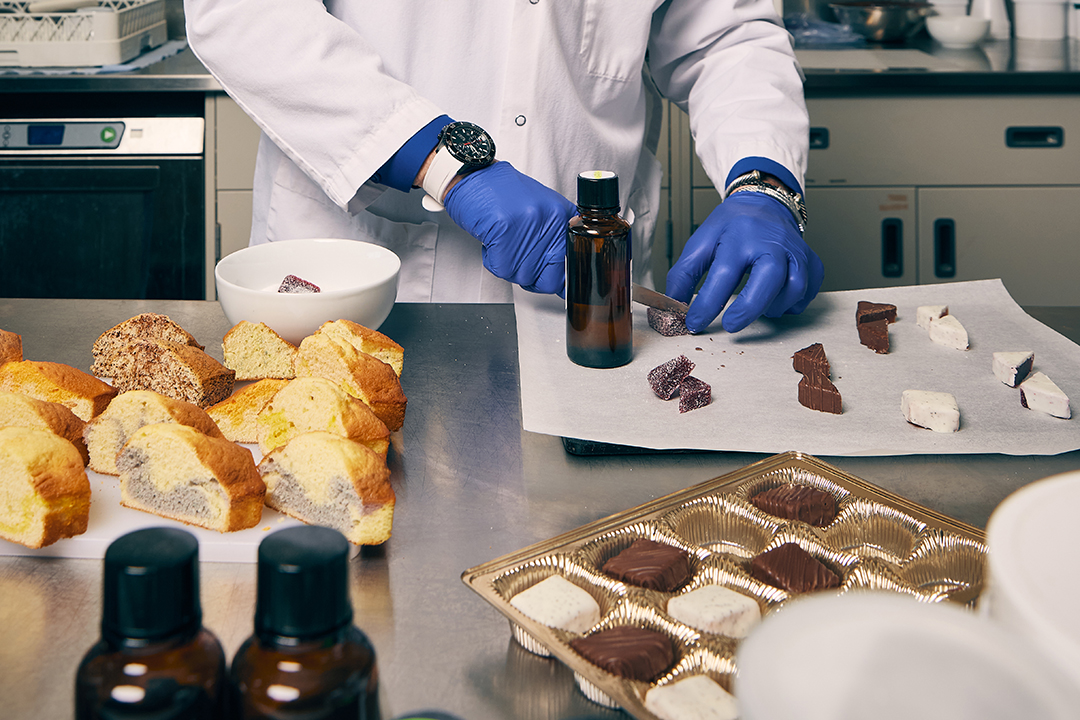
Standing inside a laboratory in Lebanon, Ohio, MANE’s Senior Vice President for Research and Development Rob Wieland grabs a jar off a shelf in front of him and unscrews the lid. “What do you smell?” he asks. A scent of almond wafts from the jar. He opens another. Butter. And another. Banana.
Flavorists at MANE use powdered essences to build new flavors every day, he says, because he and thousands of others in the flavor industry in the Cincinnati region are in the business of capturing consumers’ senses. Billions of people around the globe consume their creations daily. They may be flavoring your favorite potato chip or seltzer or enhancing the taste of your coffee or yogurt. Maybe even adding a boost of protein, energy, or probiotics.
“The flavor industry is in an exciting period of transformation,” says Mindy Kucks, president of North America Commercial for Givaudan, the world’s largest manufacturer of flavorings and fragrances that placed its North American headquarters in Cincinnati. “Consumers are looking for great taste that also supports their well-being and sustainability goals. And this motivates us to keep innovating.”
Flavor is big business. Valued between $16 billion and $21 billion per year, market forecasts predict the industry will expand at a compound annual growth rate of about 5 percent over the next decade. “Increasing demand for processed food and beverages acts as a primary catalyst for this financial trajectory,” a January forecast from Future Market Insights reads. “Product developers are shifting focus from synthetic additives to plant-based extracts, redefining procurement habits in major global economies. Such behavioral changes encourage ingredient suppliers to introduce comprehensive natural flavor portfolios utilizing advanced extraction technologies.”
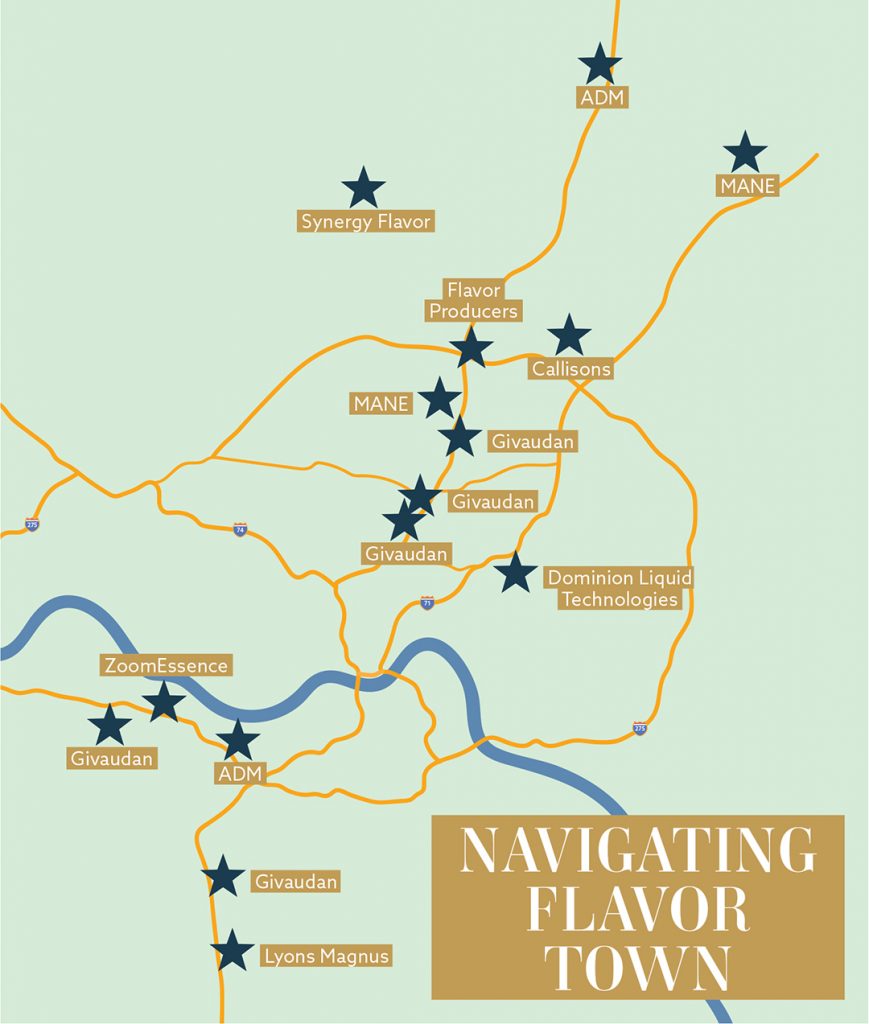
These shifts are playing out today across Cincinnati, home to almost a dozen flavor companies. The regional ecosystem includes powerhouse Givaudan, the Swiss multinational corporation whose flavors and fragrances touch a whopping 70–80 percent of global households every day; MANE Inc., an affiliate of the largest privately-owned flavor company in the world, headquartered in France, with flavor operations based in Lebanon and Woodlawn; and Archer-Daniels-Midland (ADM), based in Chicago but with its flavor and color business in Erlanger. Several other medium- to small-sized flavor houses pepper the region from Hamilton to Walton.

The industry developed in this region for many reasons, past and present, says Kimm Lauterbach, chief executive officer at REDI Cincinnati, the region’s economic development initiative. Key motivations include Cincinnati’s location, less than a day’s drive to 60 percent of the U.S. population; its long history in food and beverage manufacturing (we’re not called Porkopolis for nothing); and access to talent. “We’re fortunate because we have all these great assets for a business decision, but you can have great assets and not have a really livable region,” says Lauterbach. “When we’re recruiting our foreign companies, they’re always blown away. They say, I had no idea about Cincinnati’s arts, the culture, the food, the nightlife, the entertainment, the neighborhoods, the feel.”
Many of these companies have doubled down of late. MANE opened a $100-million facility in Woodlawn in spring 2025 to expand its ability to produce liquid flavors, and ADM is in the midst of a $46-million expansion on its Erlanger campus. Givaudan is exploring a project, also focused on producing liquid flavors, at the former Dow Chemical plant in Reading.
Smaller companies are making moves, too. ZoomEssence completed a $1-million expansion to its operations in Hebron last year, a couple of miles from the Cincinnati and Northern Kentucky International Airport. The company makes flavor products with its own patented and trademarked Zooming technology, which it recently began marketing under the brand name AmbiDry.
Creating a flavor, as one might imagine, isn’t an easy task. It involves a lot of science that rapidly developed during World War II. In 1938, the U.S. Congress passed the Agricultural Adjustment Act, which authorized the U.S. Department of Agriculture to conduct research “to develop new scientific, chemical, and technical uses” for farm commodities. With troops to feed, the agricultural supply chain tightened, so government scientists focused first on creating new and improved ways of preserving fruits and vegetables beyond their natural harvest season.
One factor everyone in the broader food and beverage industry is dealing with is a changing consumer, says ADM’s President of Global Flavors Calvin McEvoy. “Twenty or 30 years ago, you tried to design a product for a mass market to appeal to many, many consumers at once,” he says. “We’re seeing that very much go away. People want purposeful innovation and a product specific to them.”
[Photograph of MANE test-tasting work (top) by Devyn Glista]
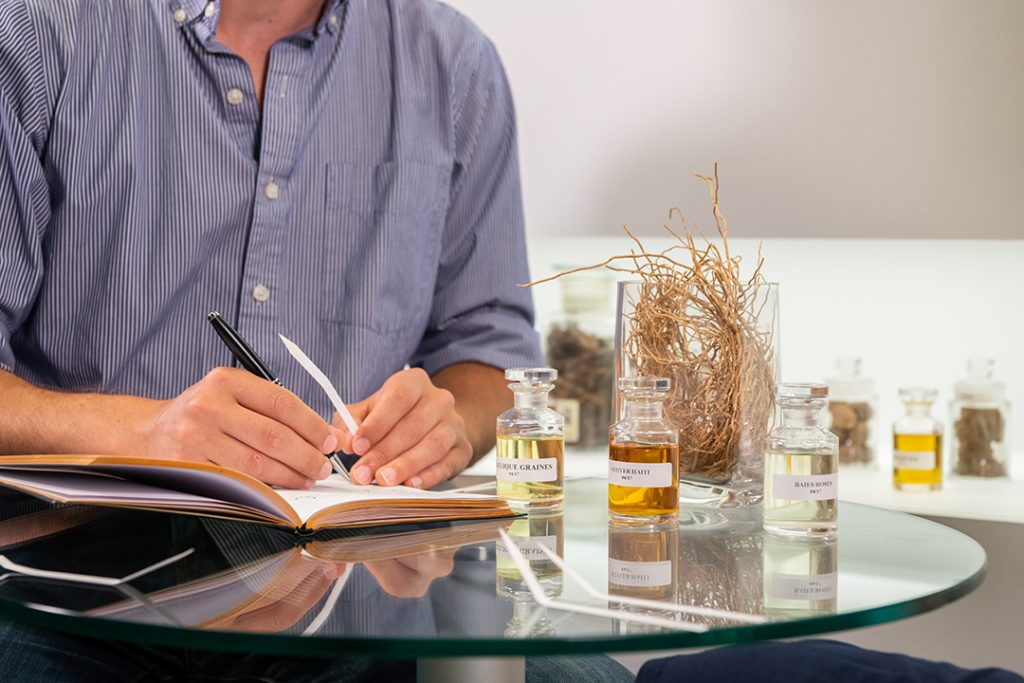
Flavor is a combination of taste and aroma—the two defining features of how we experience food, according to a landmark paper on flavor chemistry by the American Chemistry Society published in 2013. “Flavor is caused by receptors in the mouth and nose detecting chemicals found within food,” the paper explains, “and these receptors respond by producing signals that are interpreted by the brain as sensations of taste and aroma.”
After the war, those scientists “began the long process of investigating flavor compounds, and in doing so they developed numerous techniques that improved the capabilities of flavor analysis. The rapid increase in knowledge of flavor science beginning in the 1940s was powered by advances in chemical analysis.” Over the following decades, scientists built new equipment and refined methods to determine the compounds that went into flavor, like gas chromatography (to separate the compounds), static headspace analysis (testing a food’s vapor), and odor thresholds (to quantify the sensory impact).
Alex Fries gets a lot of credit as a founding father of the flavor industry in Cincinnati. He was a Bavarian-born immigrant and chemist when he began selling flavorings to whiskey makers in Kentucky in 1854, according to 2002 Associated Press feature story. Fries sold flavors and bitters out of a building on East Second Street until his death in 1907, but the business was carried on by his brother and family descendants, eventually splintering into different companies over the years. Some of the original Fries enterprise would eventually become part of Givaudan, while another offshoot would eventually become Wild Flavors, which was acquired by ADM in 2014.
“When I describe what we do, people usually have that Oh right moment when they realize how essential flavor is to everything we eat and drink,” says MANE’s North American President Amy McDonald. “It’s a surprisingly under-the-radar industry, but in this region there’s a real awareness of it, which makes a big difference when it comes to attracting talent.”
Becoming a flavorist is an arduous process. There’s an undergraduate or graduate degree in chemistry, biology, or food science, followed by a seven-year apprenticeship with a senior or master flavorist, and then a certification process with the Society of Flavor Chemists. “Few people recognize the science behind the food they consume,” reads Purdue University’s webpage about becoming a food and flavor chemist. “Food chemists focus on the chemistry of foods, their deterioration, and the principles underlying the improvement of foods for consumers.”
Cincinnati has a rich pool of graduates and experts in the field, McEvoy says. “We primarily hire food scientists, food chemists, chemistry degree graduates, biology degree graduates, culinary graduates,” he says. “So Cincinnati State, UC, Xavier, Ohio State, University of Kentucky, Purdue are all a feeder network in terms of talent within this area.”
Over the past 50 years, Cincinnati and New Jersey have emerged as the two major hubs for the global flavor industry because of their proximity to customers in the food and beverage industry, which is concentrated in the Midwest and on the East Coast, McDonald says. “Speed is incredibly important for food and beverage developers today,” she says. “They bring products to market faster than ever while navigating growing consumer pressure for more affordable options.”
MANE has thousands of customers, says Wieland, and one might call in the morning and need an ingredient manufactured, packaged, and on its way by 5 p.m. that day. “That’s the level of speed we’re moving,” he says. “We will ship out hundreds of high-value flavors today.”
MANE (pronounced “man”) employs about 900 people in the region. Its Lebanon campus focuses on dry technologies, blended technologies, and capsules, while the Woodlawn campus houses a new $100-million plant that opened last year, upping the company’s capacity to produce of liquid flavors fivefold.
“We support the full food and beverage development process from A to Z,” McDonald says. “In our development center we collaborate closely with customers to ideate around what consumers will want next, then bring those ideas to life. We conduct sensory and consumer insight work to validate emerging trends, and once concepts are approved we’re able to manufacture them right here in the Cincinnati area.”
Givaudan expects to add 300 new jobs over the next 15 years in this region. “We’re helping brands respond to evolving preferences, from sugar reduction and cleaner labels to the shift away from synthetic colors,” says Kucks. “By listening closely to our customers and investing in responsible sourcing, advanced technologies, and creative collaboration, we have the opportunity to deliver more mindful flavor experiences for people everywhere.”
ADM is one of the world’s largest processors of agricultural commodities, creating ingredients for a slew of products from foods and beverages to biofuels and home insulation. Its flavor and color business is part of its human nutrition division and is headquartered at the Erlanger campus, which it shares with the company’s global information technology division.
The company invested $48 million in upgrades in Erlanger across three projects: construction of two new customer creation and innovation centers, expansion of its manufacturing footprint, and an update to its manufacturing software system. “It’s not just about making more but making more in a more efficient, higher quality, and safer environment in terms of how we manufacture as an enterprise,” says McEvoy.
ADM employs around 1,200 people locally and has an advantage over competitors, he says, because it creates many of the base ingredients that go into making flavors. “Whether it be citrus ingredients, botanicals, natural extracts, aroma ingredients, colors, or vanilla, we have vertical integration in all those areas, which gives us more supply chain resilience,” he says. Industry leaders have cited multiple supply chain disruptions, from COVID to tariff-related and war-related issues, as challenging the industry to be innovative and keep their clients nimble.
“Food and beverage 30 years ago was a way of putting calories in your body and a way of making you feel happy and good about what you eat,” says McEvoy. “Today’s consumers are looking for a huge amount of return in terms of what they put in their bodies.”
They’re seeking out foods and beverages that contain what are known has functional blends—a juice with added vitamins or an energy drink, for instance. Some consumers want a food or beverage to deliver extra fiber or protein, perhaps prebiotics, probiotics, or postbiotics.
Since its founding in 2008, ZoomEssence has produced about 8 million pounds of flavor at its Hebron location, which underwent a $1-million expansion last year. Their trademarked Zooming technology dries materials at a lower temperature than the common methods and is protected by 31 patents, leading to maximum delivery of flavor actives, less oxidation, more dense flavor particles, and improved retention of top notes.
“We design and engineer the machines we use with physicists and engineers,” says ZoomEssence CEO Steve Hardek. “You will see us coming out with a new brand shortly called AmbiDry. We want to welcome people into the innovation center and say, What else can benefit from this low temperature drying technique that we invented?”
ZoomEssence was incubated in New Jersey but ultimately chose to locate in Northern Kentucky, says Hardek, because it was where “the smart one,” Chief Science Officer Charles Beetz, lived. Today the company has 65 employees here.
“Honestly, the state of Kentucky was great and Duke Energy came in early on to help us out,” Hardek says. “As we’ve gotten bigger over time, we found people who really wanted to challenge the industry from an innovation standpoint.”
Competition keeps building our regional talent pool, says Lee Crume, CEO of BE-NKY Growth Partnership, the economic development company for Kenton, Campbell, and Boone counties. “Competitors probably don’t want to be across the street from each other, but being in the same community has real advantages,” he says. “If people are going to move to a community, they often don’t want to work for the only employer in that sector.”

And flavor is just one component of the regional economy’s growing food and beverage sector, Crume says, which employs more than 24,000 people in the area and experienced a 19 percent increase in regional job growth between 2019 and 2024.
“Companies looking to grow, expand, or locate in Cincinnati’s 15-county region should reach out to us,” says Lauterbach. “Not because my team knows everything, but we’re that credible convener. We’ve spent 12 years now building the trust of the reputation to be able to bring together all of the right partners.”
Competition means businesses are always raising the bar, says McDonald of MANE, which recently announced a partnership with Arzeda, a U.S.-based biotechnology leader and global pioneer in intelligent protein design. That company’s generative AI technology is helping MANE explore sweetness with less sugar.
As the consumer landscape shifts, the food and beverage industry will transform. “Innovation can be an inch or a mile,” says Wieland, standing in MANE’s lab. “Making something taste better is what flavorists do every day.”