


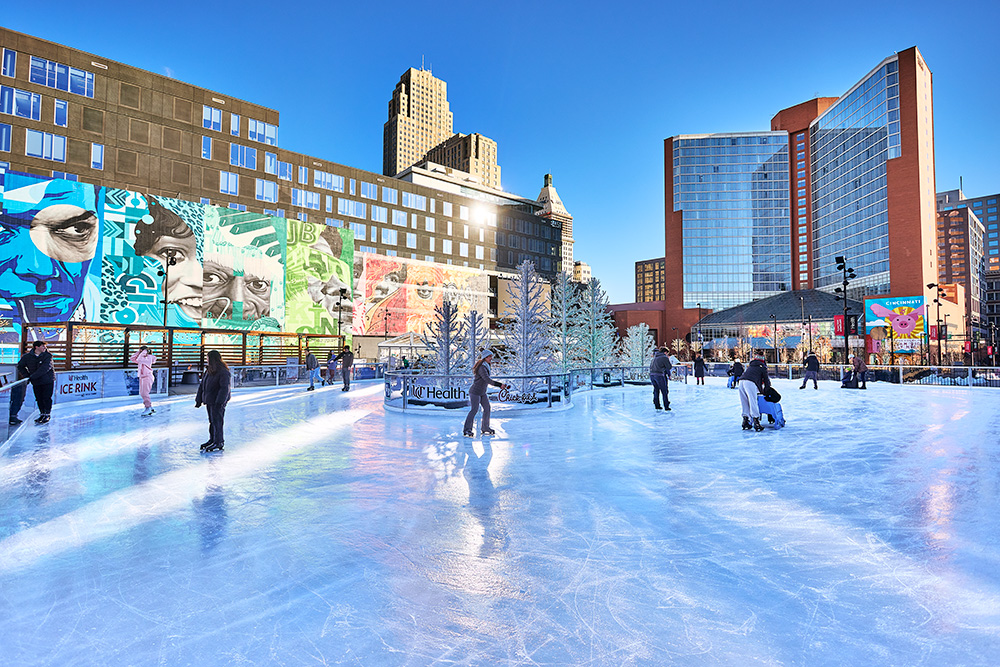
Ice skaters glide by on a skating rink on the new Elm Street Plaza, as visitors sit around fire pits or inside glass igloos enjoying a hot cocoa or a cocktail. Across Fifth Street, hungry diners enter the new Salazar restaurant, while others stroll a couple blocks east to check out Winterhaus on Fountain Square, a new 65-by-65-foot heated enclosure featuring a bar and comfortable seating. Keeping watch over it all stands the reopened Cincinnati Convention Center, which project leaders call a “total modernization” of the former Duke Energy Convention Center.
Expanded multiple times since it first opened in 1967, this is the first major remodel in 20 years. “It’s not a renovation, it’s a reinvention,” says Julie Calvert, president of Visit Cincy, the region’s destination marketing and management organization. “We’re not talking about just a fresh coat of paint. We built a brand-new convention center from the ground up.”
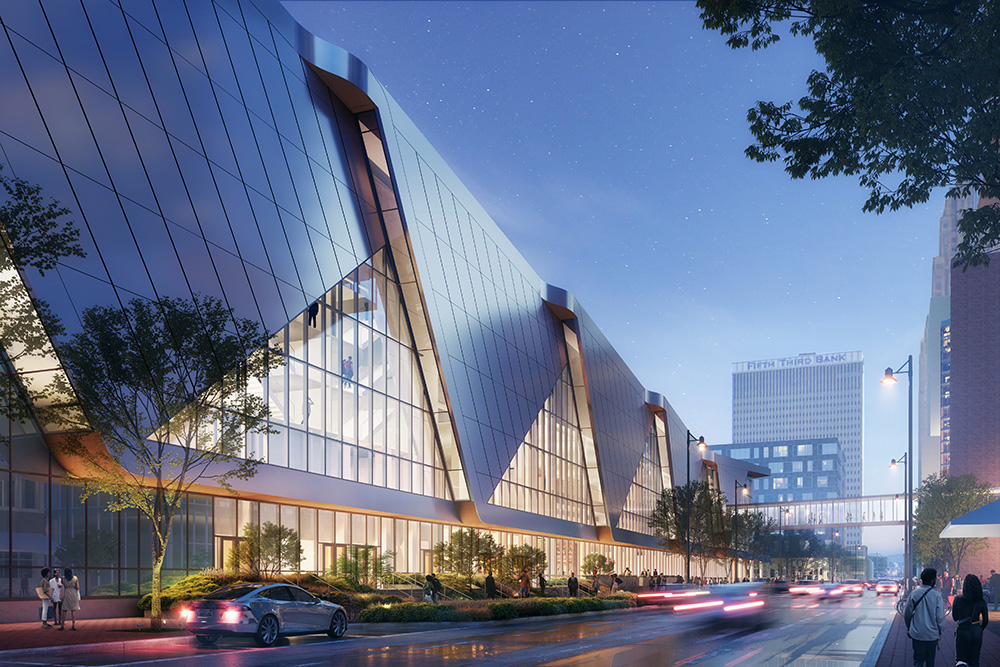
The $264-million update features a new exterior on the building, with many more windows offering convention attendees soaring views of the city and allowing natural light to fill the center. The concourses have been widened with new food and beverage alcoves and networking nooks. New mechanical, electrical, technological, and plumbing systems were installed throughout the building, along with new digital signage for each room. A new 6,000-square-foot rooftop terrace was added for outdoor meetings and social meetups.
While the center remains roughly the same overall size at 750,000 square feet, this redesign allows the space to be configured in multiple new ways so that it’s more functional and flexible and maximizes revenue opportunities, planners say. Eventually it will be connected by a skywalk across Fifth Street to a new $536-million, 700-room Marriott convention headquarters hotel, scheduled to open in summer 2028.
These redevelopments, including the 2.5-acre Elm Street Plaza on the convention center’s doorstep and conversion of the old Saks store into Paycor offices and Salazar restaurant, will breathe new life into the southwest corner of downtown, Calvert says, while also making the city more attractive to meeting and convention planners. “We’re selling this vibrancy happening in Cincinnati,” she says. “We’re not just a city that goes into hibernation when it’s cold. We’re active 365 days a year.”
Project leaders say they’re beginning to see a return on the investment already, as convention center bookings for 2026 thus far represent $37 million in economic impact. Groups reaching out to book the convention center have been, on average, 20 percent larger than before the district’s revitalization, according to statistics provided by Visit Cincy.
Inside the new convention center, Director of Sales Bob Louis points out some of his favorite touches. Warm wood tones throughout the center. Accents of Rookwood tile and terrazzo flooring. The addition of Mothers’ Rooms for nursing moms. Breakout spaces in the wider concourses. New views of Carew Tower, the city’s west side, and City Hall are enticing, he says, as are massive new digital signs inside and outside that will help orient and inform visitors.
The renovation includes new and preserved art by local artists, Louis says, including the new piece “Children Building a City” by AnTevin Brown and two Charlie Harper mosaics first installed in 1967.
Louis says he’s hearing a lot of positive feedback so far from potential clients, including those who are happy that the largest ballroom (now named Cincinnatus) hasn’t changed, aside from roughly $1 million in lighting and tech upgrades. Exhibit halls on the main floor can now be divided into smaller spaces to create lounges and meeting rooms off of the main convention floor.
Another big change is that the convention center is under new management after the city ended its contract with Los Angeles-based Oak View Group. The city of Cincinnati, which owns the convention center, selected ASM Global to manage it in August 2024; ASM was acquired later by Legends and rebranded as Legends Global. The New York-based company added Cincinnati to its portfolio of roughly 450 convention centers, music venues, and sports venues around the globe—including the Dallas Cowboys, New York Mets, PGA of America, and the International and Exhibit Convention Centre in Sydney, Australia.
The center has hired Chicago-based Levy Restaurants as its exclusive food and beverage provider, Louis says, and that team will deliver “a culinary experience that is as dynamic as the guests they serve” in the center’s new eateries. Cincinnati-based Prestige AV and Creative Services is the preferred audio and visual partner, providing set design, equipment rental, technical expertise, and professional installation.
When planners got started reimagining the center, they were determined not to think of the building as “boxes where meetings happen,” says Katie Westbrook, senior vice president of development at 3CDC, which managed the design and construction project. Instead, they leaned into a look and feel that focuses on hospitality and comfort, she says.
Westbrook has been working for 3CDC for nearly 14 years, directly managing such redevelopment projects as the headquarters for Empower Media in Over-the-Rhine; Court and Walnut streets, including Kroger on the Rhine; and The Foundry, the conversion of the former Macy’s store into a mixed-use development that now houses Divisions Maintenance Group, Deloitte, and Turner Construction along with new bars and restaurants.
“Based on some of the changing dynamics of conventions wanting more outdoor space, we thought that this was the perfect opportunity to create a public plaza that would not just be a great asset to the convention center but also a catalyst for other development down there,” says Westbrook.
Project leaders decided to permanently close Elm Street between Fifth and Sixth streets so that the convention center doors open right up to the pedestrian plaza, allowing convention groups to use the space for opening receptions and client and networking events. That’s become a big selling point, Louis says.
Calvert is happy to report that, during the 18-month renovation project, Visit Cincy didn’t lose any of the annual conventions it had hosted in previous years, even though many had to find alternative venues for one or two events. The first annual event to return is Redsfest, which runs January 16-17. “We’re excited to welcome them all back,” Calvert says. “It’s like your friends that you’ve missed and they’re coming back to something that’s so much more enjoyable and so much improved.”
Planners expect the upgrades to lure bigger groups to Cincinnati, and Calvert is excited to announce one already. In July, the city will welcome its largest conference of the year, the International Conclave of the Omega Psi Phi, the first international fraternal organization founded at a historically Black college, Howard University. Today Omega Psi Phi has more than 700 chapters across the globe, including the U.S., Mexico, and China, and should attract more than 10,000 visitors to the Queen City, Calvert says.
The month before, Cincinnati will welcome back an educational conference where Advanced Placement tests for the College Board are scored. Lasting almost the entire month of June, the conference represents about 19,000 hotel nights, Calvert says.
Redevelopment in this part of downtown is being supported and financed by a series of partners. The state of Ohio pledged $46 million, the city of Cincinnati made a $30-million direct contribution, and Hamilton County Commissioners chipped in $15 million and agreed to raise the county’s Transit Occupancy Tax (TOT) by 1 percent.
Most of the $264-million price tag for work on the convention center and Elm Street Plaza ($219 million) was paid for by the issuance of public bonds by the Port of Greater Cincinnati Development Authority, backed by revenue pledged via TOT proceeds from the city and county.
The city is working on re-selling the center’s naming rights, after Duke Energy agreed to end its contract early. No matter which company gets the naming rights this time, Calvert says, the center will be referred to as the Such-and-Such Cincinnati Convention Center going forward. “Duke has been a great partner, but what city is Duke,” she says. “We really need the name of Cincinnati to be closely associated with this building so when people see it they say, Oh, that’s Cincinnati.”
The “CINCINNATI” sign on the building’s west side facing Interstate 75 has been replaced with a new LED version that Calvert calls a “digital canvas” capable of containing signature visuals like Bengals stripes or Reds or FC Cincinnati motifs.
Beyond being centrally located to many other parts of the U.S., Cincinnati makes a great host city for multiple reasons, Calvert says. “We’ve got a lot going on,” she says. “Whether you’re here for business, for a convention, or for leisure, we invite you into our story. We want you to experience the things that make Cincinnati great—our sports, our arts, our culture, our culinary, our festivals like BLINK, Oktoberfest. The city is not only alive and vibrant, but we create a sense of belonging for anybody to be here.”
Thus far, the convention center has meetings booked as far out as 2029 and is now entertaining bids through 2031.
These redevelopment projects are now part of the city’s Fountain District, project planners say, offering a plethora of locally owned restaurants like Jeff Ruby’s Steakhouse, The Davidson, Marigold, Via Vite, Maplewood, Mita’s, Salazar, and Baru as well as unique entertainment venues like the karaoke bar Tokyo Kitty, simulated golf experience at Five Iron Golf, and recently opened interactive dart bar and restaurant Flight Club.
The convention center is also in walking distance of The Banks and Smale Riverfront Park, the city’s sports stadiums to the south, and historic Over-the-Rhine to the north, with nearby access to the streetcar connecting visitors to Findlay Market and everything in between.
“We are all really excited to be adding another civic space, Elm Street Plaza, to our portfolio,” says Joe Rudemiller, spokesman for 3CDC. “It will impact what Visit Cincy and Legends Global can do in terms of bookings, but we’re also really excited about what it’s going to do for the southwest quadrant of downtown.”
When Elm Street Plaza is not being used by conventioneers, it will be managed and programmed by 3CDC, similar to arrangements at Fountain Square and Washington Park. The UC Health Ice Rink was moved from the square to the plaza this winter and enlarged; it remains open for public skating through mid-February. When it’s removed, an interactive water fountain will become the focal point in warmer months. More public art will be installed through partnerships with a local artist collective, Black Art Speaks, and AGAR arts marketing agency.
The Marriott headquarters hotel will be developed and owned by Atlanta-based Portman Holdings, which also purchased the nearby Westin Hotel with plans to update it.
If you include the WHEX parking lot redevelopment on Fourth Street, which will create parking for the convention hotel and the public, total updates in the area so far represent an $828 million investment, Rudemiller says. “It has been a collaborative effort among public and private parties across all sectors,” he says. “We think the reward to the region is going to be increased attendance, bigger and better conventions coming to town, and a massive boost overall to the regional economy.”
Properties adjacent to the convention center are sparking redevelopment interest, too, Westbrook says, including the former Convention Place Mall at 435 Elm Street, which was torn down in 2024 and is development ready. The Port Authority plans to demolish a garage it owns at Sixth and Elm streets, and Brent Spence Bridge reconstruction will eventually open up another 8-10 acres of land west of the convention center, Rudemiller says. “I don’t know how the community ultimately wants to develop that,” he says, “but we think that’s another area the city can take advantage of.”
Visitors spend $6.5 billion annually in Hamilton County, and roughly 67,000 jobs are supported by the tourism industry in our region, with visitor spending resulting in $352 million in local taxes in 2024. “This city is constantly reinventing itself,” says Calvert, who has been selling the Cincinnati experience for 30 years. “Good enough is not good enough. You want to be great.”
Visit Cincy and its partners, including the new Cincinnati Regional Sports Commission, have made it clear that they want to host the NFL Draft one of these years, for example, and the revamped convention center, new hotel, and all of the development around it will up the city’s ante, Calvert says.
She hopes that local organizations and business leaders will stop to consider the convention center—as well as Cincinnati’s other meeting spaces like the Sharonville Convention Center and the Northern Kentucky Convention Center—for their future meetings and gatherings. “Whether you’re small or you’re large, have your meeting in Cincinnati,” says Calvert. “Be an active part of selling this city. Be loud, be proud.”